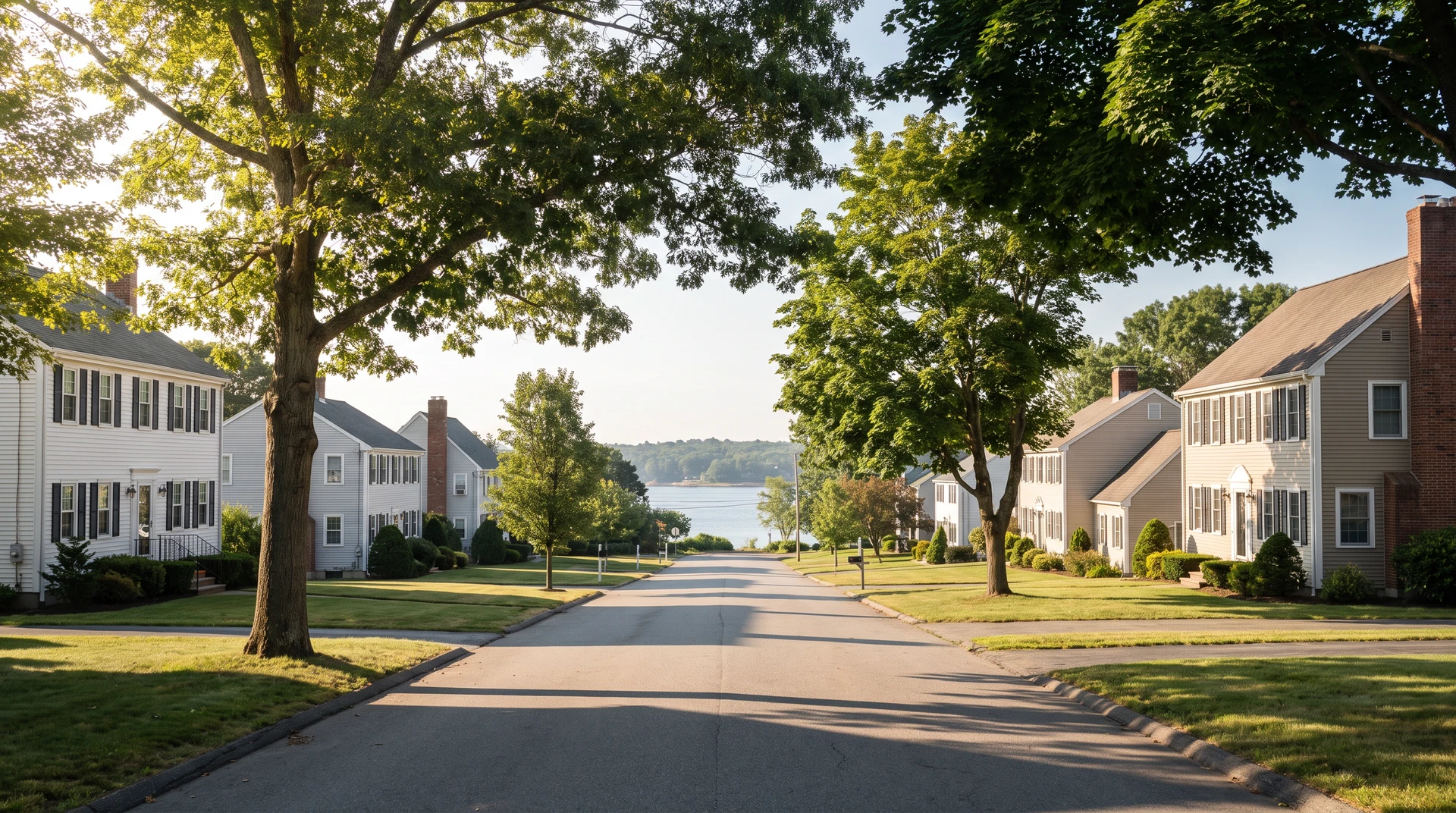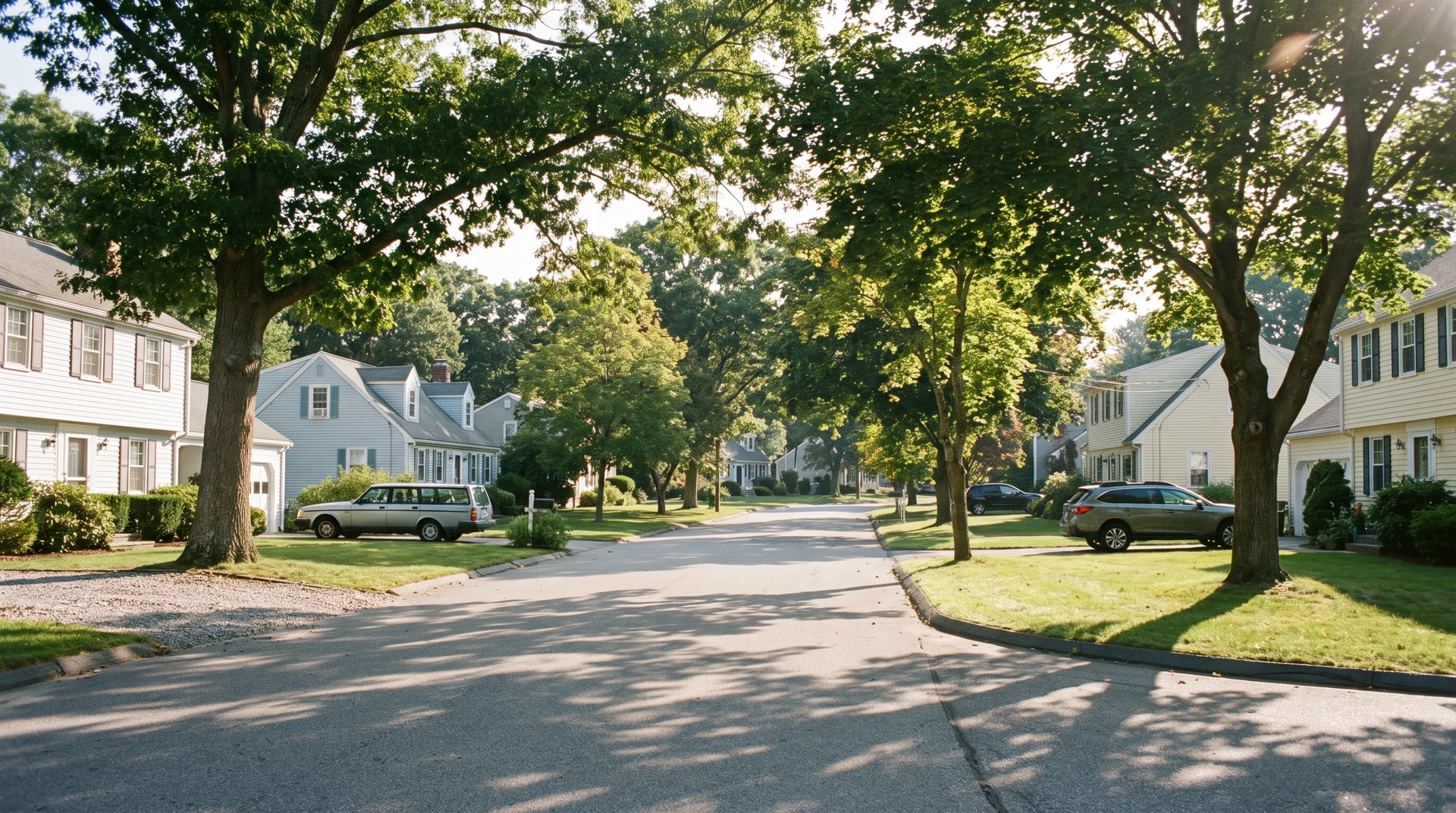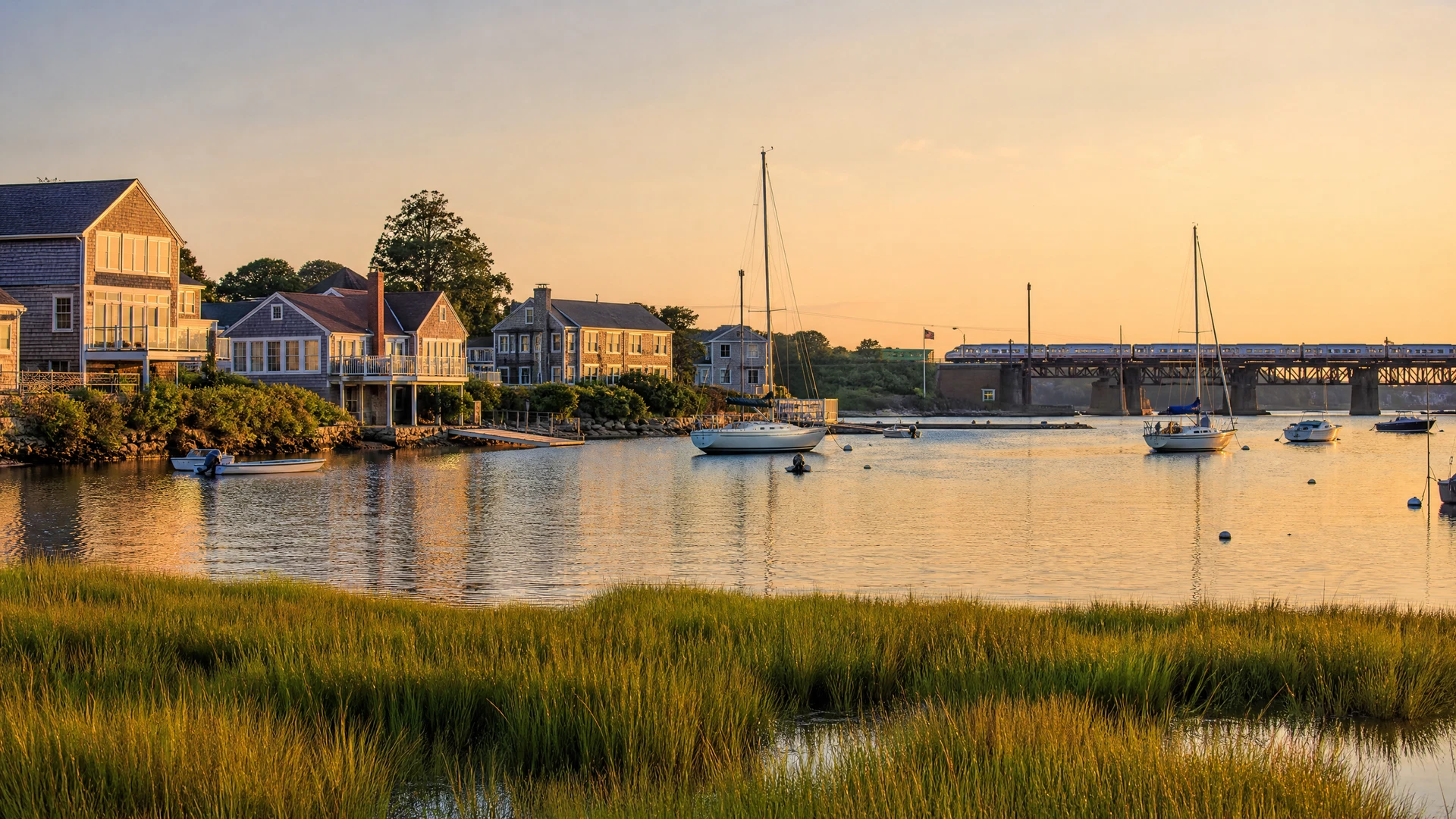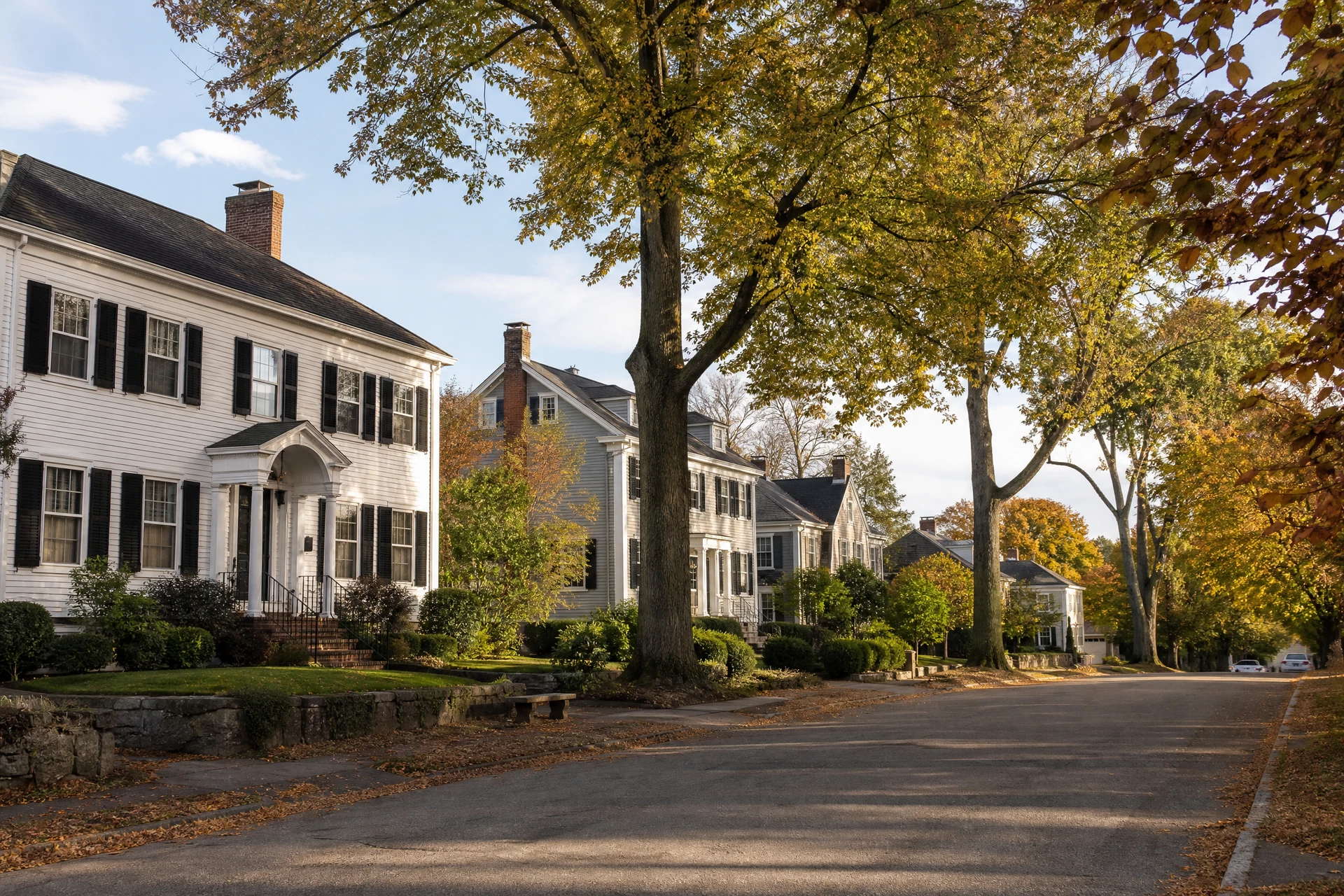
Milton is one of the most expensive places to buy on Boston's southern edge, with single family homes generally trading somewhere between $1 million and $1.2 million through 2026. For that, you get a town that runs right up against Boston along its northern and northwestern edges, four trolley stops that feed the Red Line, and a share of the 7,000 acre Blue Hills Reservation.
What you do not get is a commuter rail station. Milton has none. That single fact shapes more of the Milton decision than price does, because it determines who the town works for and who ends up frustrated by it eighteen months in.
Who this applies to
You are looking in the $900,000 to $1.4 million range on the south side of Boston, and Milton keeps coming up next to Quincy, Braintree, Canton, and Dedham. You want to be close to the city without living in it, you care about schools and open space, and you are trying to work out whether Milton's premium over its neighbors buys you anything real.
If you commute into downtown Boston daily, read the transit section carefully before anything else. If you are weighing Milton against a town further out, the tax section below will matter more than the sticker price.
What homes actually cost in Milton
Single family sale prices in Milton have generally run in the $1 million to $1.2 million range in 2026, though the exact figure moves with the mix of what sold in any given month. A quarter heavy on smaller Lower Mills capes reads very differently from one with three Milton Hill sales in it. Price ranges checked against Milton's own planning materials and published 2026 market reports in August 2026.
Watch for a trap in the numbers you will see online. A townwide median that mixes property types is not the same number as a single family median, because Milton has a real condominium and two family inventory concentrated in East Milton and Lower Mills. Depending on which month you look at and what sold in it, the mixed figure can land well under $1 million or well above it. Consumer real estate sites illustrate the spread in 2026: an all-property-types median for the town has been quoted just under $1 million, while single family measures for the same year run around $1.15 million to $1.24 million. Quoting one of those numbers at the other is the most common way Milton gets misread. Ask what any figure you are shown actually covers, over what period, and from which source.
Against its neighbors, Milton generally commands higher single family prices than Quincy, Braintree, and Randolph, sits in a similar tier to Canton and Dedham, and typically prices below Hingham, Needham, and Newton. Treat that ordering as directional rather than as a set of numbers. The exact ranking flips by property type, by price band, and by how many high end sales landed in the period, and Canton or Dedham can come in above Milton in any given quarter. If you want a real comparison, pull rolling twelve month single family medians from one consistent source rather than reading a headline number off a different site for each town.
Getting into Boston from Milton
Milton has four MBTA stations, all of them on the Mattapan Line: Milton, Central Avenue, Valley Road, and Capen Street. Cedar Grove and Butler, the two stops just before them, are in Dorchester rather than Milton, which is a common enough mix-up that it is worth naming.
The Mattapan Line is light rail, not heavy rail. It runs 1940s PCC streetcars, it is part of the Red Line for fare and map purposes, and you transfer at Ashmont to reach the rest of the Red Line and downtown. Valley Road is the only station on the entire line that is not accessible, which matters if anyone in your household uses a wheelchair or a stroller.
There is no commuter rail station anywhere in Milton. Milton commuters who want the train drive to a station in another town, and Milton drivers who want the Red Line with parking generally use the Quincy Adams or Braintree garages. I-93 runs through this side of town, which is convenient when it is moving. At East Milton Square there is a deck built over the highway, Manning Community Park, which is an unusual piece of infrastructure and stitches the area back together where the road cut through it.
So the honest transit summary is this: Milton is excellent for a Red Line commuter who is happy to take a trolley and transfer, and mediocre for anyone whose job sits on a commuter rail line. Buyers who assume "close to Boston" means "easy train" are the ones who get surprised.
What you will actually pay in property taxes
Milton's fiscal 2026 residential rate is $11.81 per $1,000 of assessed value. That is higher than Braintree or Canton and almost identical to Quincy, which surprises people who expect the pricier town to have the lower rate.
The rate on its own tells you very little, because your bill is the rate multiplied by your assessment. The column that matters is what the same house would cost you in each town.
| Town | FY2026 residential rate | Tax on $1,000,000 of assessed value | FY2026 commercial rate |
|---|---|---|---|
| Milton | $11.81 per $1,000 | $11,810 | $18.12 per $1,000 |
| Quincy | $11.78 per $1,000 | $11,780 | $23.53 per $1,000 |
| Braintree | $10.06 per $1,000 | $10,060 | $21.39 per $1,000 |
| Canton | $9.75 per $1,000 | $9,750 | $19.67 per $1,000 |
Rates checked against each town's own assessor page and the state's FY2026 rate compilation in August 2026. For scale, the Massachusetts Division of Local Services reported that for fiscal 2026 the average single family home statewide is assessed at $742,986, with a statewide average single family tax bill of $8,113, up from $7,730 the prior year, and a median of community averages of $6,829. That $8,113 is a statewide average of community figures, not what any particular owner pays, so treat it as a yardstick rather than as your bill.
Read the table this way. Milton and Quincy charge nearly the same rate, so on identical assessments the bills are nearly identical, and the reason a Milton tax bill runs so much higher than a Quincy one is the assessment, not the rate. Canton charges about $2 per $1,000 less than Milton, which is roughly $2,000 a year on a $1 million house, or about $167 a month added to your carrying cost. That is real money, and it is the kind of thing worth putting into your affordability math before you fall in love with a street. If you are buying at an age where exemptions apply, the senior property tax programs are worth checking against your numbers too.
Two Milton-specific numbers belong in your math, and they are the ones that actually explain the bill. In its own override materials the town put the average single family assessed value at $1,028,457, which is why the $1,000,000 column above sits close to a real Milton bill rather than a hypothetical. And on April 29, 2025, Milton voters approved a $9,500,000 Proposition 2 1/2 operating override by 5,566 to 3,215, with $5.7 million of it going to the public schools. The town projected the override would add about $1,063 to the average single family bill, taking it to roughly $12,857 for fiscal 2026 against about $11,794 had it failed. Treat those as the pre-certification estimates they were rather than as final bills. The part that is settled is the direction, because an override permanently raises the levy limit and is in the base from here forward. Override figures checked against the Town of Milton's own FY2026 override page in August 2026.
That is the single most useful thing a buyer can know about Milton's taxes, and it is why comparing rate to rate across towns is close to meaningless here. Milton just voted to tax itself more, on assessments that are already among the higher ones in the area.
One more note on Milton's commercial rate, which is the lowest of the four towns above. Milton's tax base is predominantly residential, with a smaller commercial and industrial component than the towns around it that host offices, retail centers, or industrial parks. That means residential property makes up a substantial share of the town's taxable value, and it is a structural feature of Milton rather than a temporary one. If you want the actual split, the Assessors' Office publishes assessed values by class in its annual tax classification materials.
The zoning fight, and what it means if you are buying here
If you have heard anything about Milton in the last three years, it was probably this. It is worth understanding as a buyer, because it is not an abstract political story. It has already cost the town money.
Milton is classified as a rapid transit community under the MBTA Communities law, which is the highest tier of obligation, and it is classified that way because of the Mattapan trolley. The town asked both the MBTA and the state to reclassify it on the grounds that a 1940s streetcar is not really rapid transit. Both declined. The MBTA confirmed the line's designation in September 2023 and the state confirmed Milton's classification the following month.
That tier sets a specific requirement. Milton has to zone at least one district of at least 50 acres, at a minimum gross density of 15 units per acre, with at least half the district area within a half mile of a Mattapan trolley station, open to families and not age restricted. Because Milton has 9,844 year-round housing units, the 25 percent standard means zoning with capacity for at least 2,461 multi-family units. Note the word capacity. This is a zoning obligation, not a construction quota, and nothing in it requires that those units get built.
Here is how it actually unfolded:
- In December 2023, Town Meeting approved zoning that would have brought Milton into compliance by the state's December 31, 2023 deadline.
- On February 14, 2024, a town-wide referendum overturned that vote, and two days later the state notified Milton that it was noncompliant.
- Through 2024 the town began losing grant money over it, including a $250,000 municipal fiber award and a $55,000 ADA improvement grant.
- The Attorney General sued, and on January 8, 2025 the Supreme Judicial Court decided Attorney General v. Town of Milton. The court held the law is mandatory and enforceable, and that the Attorney General can enforce it.
- The same decision found the state's implementing guidelines had not been properly promulgated under the Administrative Procedure Act, so the state re-issued them through formal rulemaking, filing permanent regulations on March 28, 2025 that were published on April 11, 2025.
- On February 19, 2025, the state again found Milton noncompliant, this time for not submitting the required action plan by the February 14 deadline.
- On May 29, 2025, after Milton did submit an action plan, the state determined the town to be in interim compliance.
- On June 16, 2025, a Special Town Meeting took up two MBTA Communities articles and adopted rapid transit tier zoning by a comfortable margin, by way of a citizens' petition rather than the Planning Board's own article.
The money side is the part most buyers have never seen, and it is all posted publicly by the town itself. Read the right hand column carefully, because these are not all the same thing. Some applications were rejected outright over noncompliance, while other awards were made and simply had their release conditioned on it:
| Grant | Amount | What happened | Date |
|---|---|---|---|
| Municipal fiber program | $250,000 | Application rejected for noncompliance | June 6, 2024 |
| Seaport Economic Council seawall project | $140,800 | Awarded, but conditioned on compliance | January 26, 2024 |
| Municipal ADA improvement grant | $55,000 | Application rejected for noncompliance | November 21, 2024 |
| Community Compact IT grant | $110,000 | Not awarded, did not score high enough; compliance was also a condition | April 2, 2025 |
| Council on Aging replacement bus | $97,334 | Application denied for noncompliance | April 4, 2025 |
| Clean Water State Revolving Fund | $150,000 | Awarded, but release conditioned on compliance | April 8, 2025 |
Dates and figures checked against the Town of Milton's own MBTA Communities page in August 2026.
What this means for you as a buyer is narrower than the volume of the argument suggests. It does not change what you can do with a single family house you buy in Milton. It does mean the town's finances took a real hit during the standoff, and it does mean that if you buy near one of the trolley stops, the zoning around you now permits denser housing than it did in 2023.
This story has also moved repeatedly, including a statewide effort to put the mandate itself back on the ballot. If your purchase decision turns on Milton's compliance status or on the zoning of a specific parcel, confirm the current position with the Milton Planning Department rather than relying on any article, including this one.
Schools, and the institutions around them
Milton Public Schools runs four elementary schools, Collicot, Cunningham, Glover, and Tucker, plus Pierce Middle School and Milton High School, which offers a French immersion program that is unusual for a district this size and is a genuine draw for some families.
The private and higher education presence is heavier than the town's size would predict. Milton Academy sits in the middle of town, along with Fontbonne Academy and Thacher Montessori, and Curry College is here as well. That concentration is part of why Milton feels less like a bedroom suburb than its population of about 28,600, as of the 2020 Census, would suggest.
One practical note. Elementary assignment in a district with four schools is not always intuitive, and it is not something to assume from a listing sheet. If a specific school is driving your search, verify assignment for the exact address with the district before you write an offer, not after.
The Blue Hills, and what 7,000 acres next door actually does
The Blue Hills Reservation covers roughly 7,000 acres across Milton, Quincy, Braintree, Canton, Randolph, and Dedham, managed by the state Department of Conservation and Recreation. Great Blue Hill reaches 635 feet, the highest of the 22 hills in the chain, and the reservation carries about 125 miles of trails. The Blue Hill Meteorological Observatory at the summit, established in 1885, is the oldest continuously operated weather observatory in the United States. Reservation figures checked against the Department of Conservation and Recreation's own page in August 2026.
For a buyer, this is not just scenery. A large permanently protected reservation on one border means a meaningful share of Milton can never be developed, which supports values over time and is part of what you are paying the premium for. It also means trail access from residential streets, which is a real quality of life difference from towns where the nearest open space is a drive away.
The parts of Milton, and how they differ
Milton is not one market. East Milton Square is among the town's densest and most walkable mixed use areas, with a concentration of condominium and multi-family inventory, sitting right at the highway. Lower Mills, at the Neponset River along the Dorchester line, has the most urban feel and the shortest walk to the trolley, and it is really a shared district straddling the Milton and Boston line rather than a Milton neighborhood alone. Milton Hill is the town's best known historic residential area, with substantial homes and some of its highest prices, though Brush Hill and the river-adjacent pockets compete depending on which measure you use. The southern and western stretches toward Blue Hills and Canton are more suburban, with bigger lots and a longer drive to everything.
Those differences are large enough that a price per square foot pulled from a town-wide report will mislead you in any one of them. Comp against the specific pocket, not against Milton.
Milton also runs on representative Town Meeting, a form it adopted in 1927, with 279 elected members across ten precincts. That is worth knowing because it is how decisions like the zoning vote above actually get made, and it is a slower and more deliberative process than a city council.
What to check before you write an offer in Milton
The housing stock skews older, which brings the usual Massachusetts obligations into play. For homes built before 1978, state and federal law require the seller and the agents to give you the Property Transfer Lead Paint Notification package, along with any known lead information and any inspection or compliance reports that exist, before you sign the purchase and sale agreement. The seller also arranges a local fire department inspection and obtains the smoke and carbon monoxide Certificate of Compliance before closing. Do not assume a fixed validity window on that certificate, since practice is administered locally and the periods quoted online conflict. Ask the Milton Fire Department how long the certificate it issues stays good, especially if your closing is likely to move. Confirm whether the specific property is on town sewer or a private septic system, because a Title 5 inspection obligation follows the answer.
On the estate side, Milton is in Norfolk County, so probate matters run through the Norfolk Probate and Family Court at 35 Shawmut Road in Canton, and deeds record at the Norfolk County Registry of Deeds at 649 High Street in Dedham. If you are buying from an estate, that is where the paperwork lives, and the timeline of the estate will drive your closing date more than your lender will. Budget for the closing costs a Massachusetts buyer actually pays on top of your down payment, and get clear on whether you are in a buyer's or seller's market in the specific price band you are shopping, because Milton behaves differently at $850,000 than at $1.4 million.
The bottom line
Milton is worth its premium if you want proximity to Boston, protected open space, and a strong school district, and if the Mattapan trolley plus a transfer at Ashmont is a commute you can actually live with. It is not worth the premium if you need commuter rail, because Milton has none and the towns that do are cheaper.
The property tax rate is not the reason Milton costs more to own. The assessments are. Run the real number on a specific house before you decide, and compare it against Canton or Braintree on the same assessment rather than on the rate alone.
FAQ
Common questions, answered.
Does Milton have a commuter rail station?
No. Milton has no commuter rail station. Its four MBTA stations are all on the Mattapan Line, which is light rail connecting to the Red Line at Ashmont. Commuters who need the train drive to a station in a neighboring community.
Are property taxes high in Milton?
Milton's fiscal 2026 residential rate of $11.81 per $1,000 is mid-range for the area, close to Quincy and above Braintree and Canton. Bills run high because assessments are high, not because the rate is. On a $1,000,000 assessment the tax is $11,810, against a statewide average single family bill of $8,113 for fiscal 2026. Milton's average single family home is assessed at about $1,028,457, and voters approved a $9,500,000 Proposition 2 1/2 operating override in April 2025, so bills here are set to run well above the state average going forward.
Is Milton part of Boston?
No. Milton is a separate town in Norfolk County with its own government, schools, and taxes. It borders Boston's Dorchester, Mattapan, and Hyde Park neighborhoods, which is why the two are often confused, and its population was 28,630 at the 2020 Census.
What was the Milton MBTA Communities zoning fight about?
Milton is classified as a rapid transit community because of the Mattapan trolley, which requires it to zone for capacity of at least 2,461 multi-family units. Voters overturned a compliance vote in February 2024, the Supreme Judicial Court ruled against the town in January 2025, and Town Meeting adopted qualifying zoning on June 16, 2025. In the interim the town had grant applications worth more than $400,000 rejected or denied over noncompliance, and had other awards conditioned on it.
Monthly Market Recap
Get the Greater Boston market recap, once a month.
Prices, inventory, and what it actually means for buyers and sellers around Quincy and the South Shore.