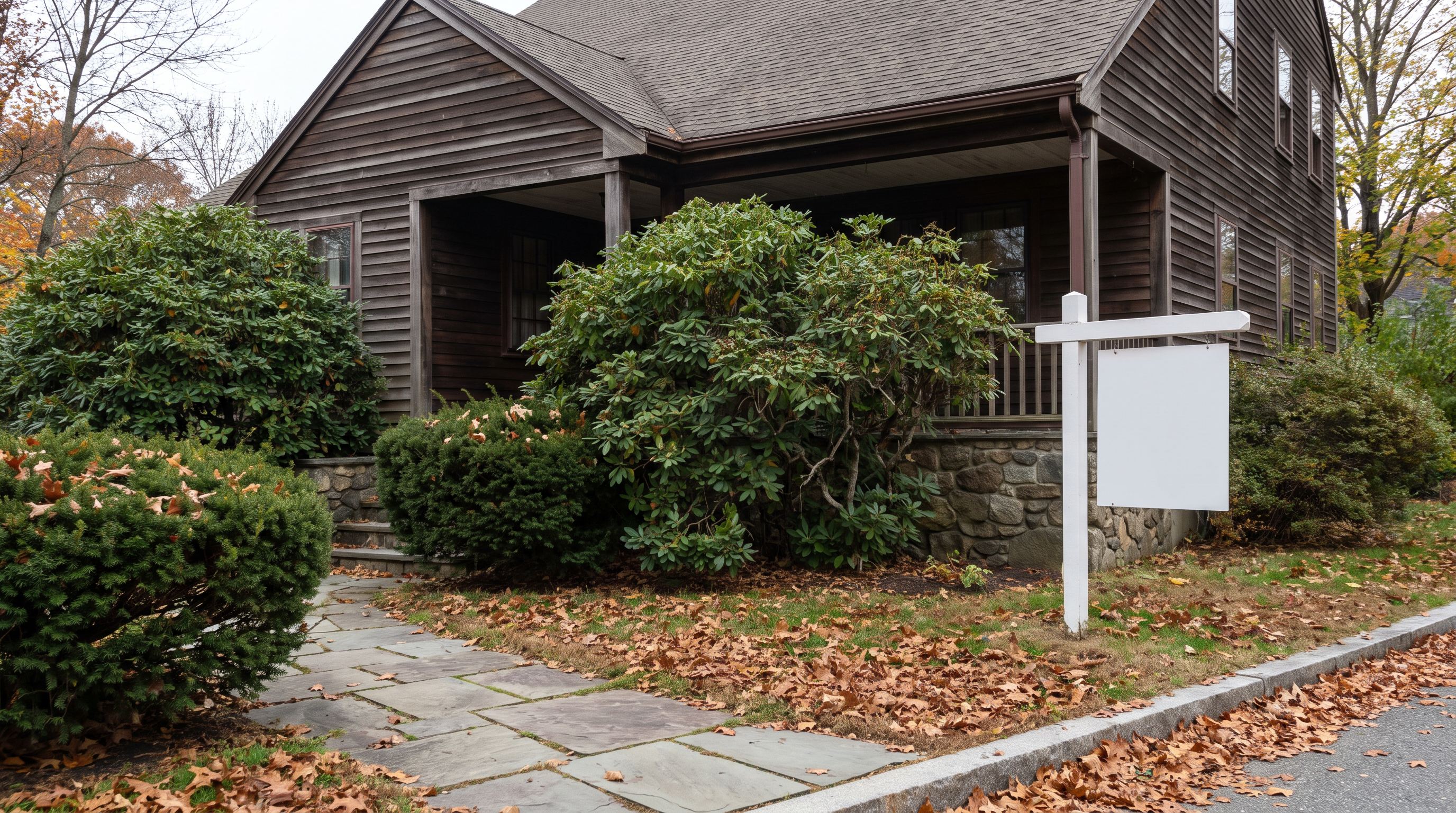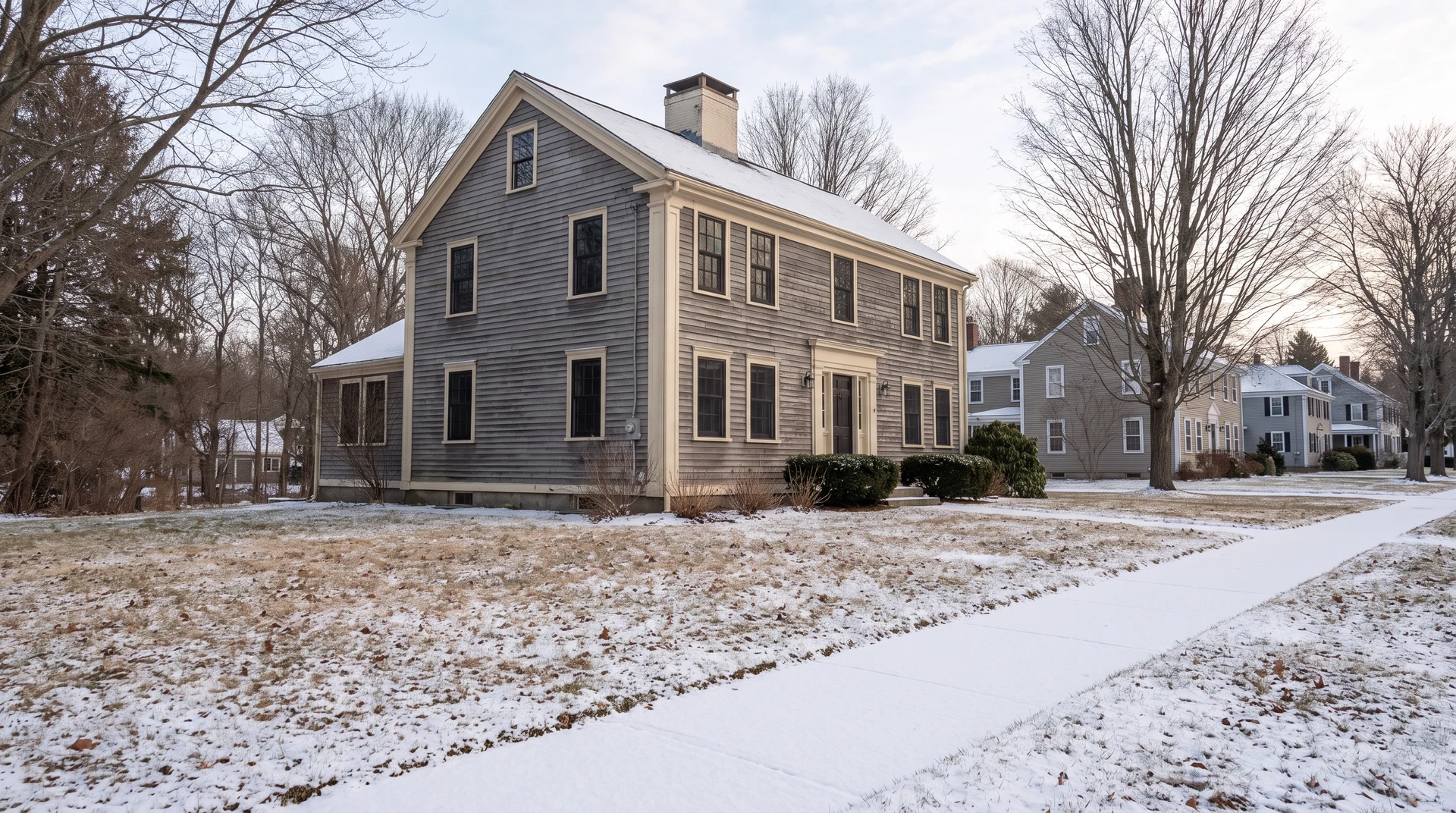
An empty inherited house in Massachusetts fails in a predictable order: the insurance goes first, the plumbing goes second, and the liability shows up last. The thing most heirs get told is that a house goes uninsured after 60 vacant days. That is not quite right, and the real risk is worse, because the two coverages that actually matter for an empty Massachusetts house in January are not governed by the vacancy clock at all.
This is Step L of the Inherited with Clarity Method, lock down the house. It comes early in the framework for a reason. Everything you will eventually decide, whether to keep it, rent it, buy out a sibling, or sell it, assumes the house is still standing and still insured when you get there.
Who this applies to
You are the personal representative, or you expect to be, and the house is empty. Nobody sleeps there. Maybe a neighbor has a key, maybe a sibling drives by on weekends, maybe you live in another state and have not seen the place since the funeral.
It applies hardest if you are handling this from out of state, where you cannot drive over on a cold night and every fix has to be arranged by phone. If that is you, the mechanics of selling from out of state are a separate problem worth reading on their own.
It also applies if the house is technically furnished and the utilities are technically on, but nobody is living in it. Insurers care about occupancy, not about whether the furniture is still there. A house full of a lifetime of belongings with nobody in it is an empty house as far as the policy is concerned.
If the house is occupied, by a surviving spouse, a tenant, or a family member who moved in, most of this does not apply and you have a different set of questions.
What actually happens to the policy when the owner dies
The homeowners policy does not vanish the afternoon of the funeral. The standard homeowners form has a Death condition, and it says the insurer covers the legal representative of the deceased, but only with respect to the premises and property of the deceased covered under the policy at the time of death.
There is a second half to that condition that almost nobody tells heirs about, and it is genuinely useful in the gap before anyone is appointed. The same provision extends insured status to the person having proper temporary custody of the property until a legal representative is appointed and qualified. So the sibling holding the keys in week two is not standing outside the policy.
What it is not is a permanent arrangement. It is a bridge to the estate getting properly insured, and two clocks run underneath it. The first is the vacancy clock, which starts when the house empties and does not care that probate has not opened. The second is the renewal date, which is when the carrier asks who lives there now and who is paying.
The failure mode is quiet. The premium gets paid out of an account somebody is still watching, the declarations page still has the right address, and the house looks insured, right up until an adjuster asks how long it has been empty. The uglier version: the premium comes due, nobody knows to pay it because the person who always paid it is the person who died, the policy lapses, and the estate learns this at the same moment it learns about the burst pipe.
Policy language in this section was checked against the ISO Homeowners 3 Special Form in August 2026. Forms and endorsements vary by carrier, and your actual policy is the one that governs, so pull the declarations page and the form rather than trusting any article, including this one.
The 60-day vacancy clause is narrower than you have been told
Search this topic and you will find a widely repeated list: after 60 vacant days you lose vandalism, theft, glass, water damage, and sprinkler leakage, and everything else gets cut by 15 percent. That list is real, but it is the vacancy provision from commercial property coverage. It is not what a standard homeowners form says, and repeating it at an estate is how people end up solving the wrong problem.
Under the standard homeowners form, vacancy past 60 consecutive days does exactly two things.
| Loss type | Standard homeowners form after 60 vacant days | Typical commercial or vacant property vacancy clause |
|---|---|---|
| Vandalism and malicious mischief | Excluded, including ensuing loss from the wrongful act | Excluded |
| Glass and safety glazing breakage | Excluded, with an exception where the breakage results directly from earth movement | Excluded |
| Theft and attempted theft | Not excluded by the vacancy clause, though theft is separately restricted in a dwelling under construction | Excluded |
| Water damage | Not excluded by the vacancy clause, but see the freezing rule below, which is the real exposure | Excluded |
| Sprinkler leakage | Not excluded by the vacancy clause | Excluded unless the system is protected against freezing |
| Everything else, including fire and wind | Paid in full, with no vacancy penalty | Paid, reduced by 15 percent |
Two practical takeaways. First, if someone quotes you the 15 percent penalty on a homeowners policy, they are reading the wrong form. Second, and this is the part that matters, that right-hand column is not irrelevant to you, because a carrier that will not renew a homeowners policy on an empty estate house will often move it onto a dwelling fire or vacant property policy, and those forms carry the broader vacancy language. The commercial-style clause becomes your clause the moment the house changes policy type.
Also note what the form says about a house that is being worked on: a dwelling being constructed is not considered vacant. Renovating before a sale is treated differently from letting a house sit.
The freezing rule has no vacancy clock, and it is the one that gets estates
Here is the exposure the 60-day conversation distracts from. The standard homeowners form excludes loss caused by freezing of a plumbing, heating, air conditioning, or automatic fire protective sprinkler system, or of a household appliance, and loss from discharge, leakage, or overflow from within any of those caused by freezing. Then it gives you one way out: the exclusion does not apply if you have used reasonable care to either maintain heat in the building, or shut off the water supply and drain all systems and appliances of water.
Read that again with an empty house in mind. There is no 60-day grace period. There is no vacancy trigger. The test is simply whether you did one of those two things, and it applies on night one. A pipe that lets go in an unheated, undrained inherited house in January is the single most likely large loss the estate will face, and it is the one the policy is most clearly set up to decline.
| Keep the heat on | Shut the water off and drain | |
|---|---|---|
| What it actually means | Heat maintained through the winter, the fuel or gas account kept open and paid, and someone confirming the heat is still running | Water off at the main or the curb, then every supply line, fixture, appliance, and water-filled heating system fully drained |
| What it costs | A winter of heating an empty house in Greater Boston, plus fuel deliveries nobody is home to receive | A plumber for a day, plus recharging the system before showings or a closing |
| Where it fails | The furnace quits, the oil runs out, or the power goes down in a January storm and nobody knows for nine days | A partial drain, especially a steam or hot water boiler, a dishwasher, a washing machine, or a trap that got missed |
| Best when | The house is being shown, or the estate expects to sell within a few months | Nobody will be in the house for a full winter, or it is far from anyone who can check on it |
One exception that reverses the answer completely: if the building is protected by an automatic fire protective sprinkler system, the standard form requires reasonable care to continue the water supply and maintain heat. Draining that house is the wrong move and can cost you the coverage you were trying to protect. Sprinklers are uncommon in older single family homes here and common in newer condos and converted multifamily buildings, so check before anyone touches a valve.
If you keep the heat on, add a low-temperature alarm and a water leak sensor that text a phone. They cost less than one drywall repair and they are the only thing that turns an unnoticed failure into a phone call. If you shut the water off, hire a plumber and use the words "winterize it fully," because the half-drained house is the one that floods.
Do not shut the electricity off to save $30 a month. The electricity runs the heat, the sump pump, the alarm, and the sensors. Worth knowing separately: the freezing peril in the standard form does not treat a sump, a sump pump, or related equipment as part of the plumbing system, so a wet basement from a failed pump is its own coverage question and often needs a specific endorsement.
How to keep an empty inherited house insured
Call the carrier and tell them the owner died and the house is empty. Heirs avoid this call because they assume it triggers a cancellation. What it triggers is a conversation about which product fits, and the carrier finding out on its own at claim time is far worse than the carrier hearing it from you now.
From there the realistic options are a carrier-specific vacancy endorsement, which suspends stated vacancy restrictions for a defined period and usually carries conditions about heat, inspections, or monitoring, or a move onto a dwelling fire or vacant property policy written for exactly this situation. Neither is automatic, both cost more than the old homeowners policy, and the scope and duration are carrier-specific. Get what you are told in writing.
Do not plan on the Massachusetts FAIR Plan as the fallback. The Massachusetts Property Insurance Underwriting Association is the state's market of last resort for applicants who cannot get coverage in the voluntary market, but state guidance lists not being vacant among the eligibility conditions, so a house sitting empty through probate may not qualify at all. Ask a licensed Massachusetts agent or broker about placement before assuming there is a backstop.
Get the named insured right. Once you are appointed, the policy should reflect the estate and the personal representative, not a deceased person and not an heir who does not hold title yet. A claim paid to the wrong party on a house owned by an estate becomes a second problem stacked on the first.
If the house has oil heat, there is a second problem
Massachusetts requires protection on the fuel line at one to four unit residences that use a heating oil tank for consumption on the premises where one or more supply or return lines are in direct contact with concrete, earth, or another floor surface, under M.G.L. c. 148, s. 38J. The owner has to enclose a supply line in a continuous non-metallic sleeve, install an oil safety valve at the tank end, or use another release prevention method the board approves. There is an exemption where the burner sits above the tank and the entire supply line connects to and stays above the top of the tank. A licensed technician certifies compliance on the state form, which goes to the local fire department.
That statute has a companion in the insurance code, and it is where an estate gets caught. Under M.G.L. c. 175, s. 4D, insurers must make heating oil release coverage available, with minimum coverage of $50,000 per occurrence for first-party property and $200,000 per occurrence for third-party liability, and a deductible that cannot exceed $1,000 per claim. The same section lets an insurer require proof that the s. 38J requirements have been met as a precondition to issuing that coverage. So the estate shopping a new policy on an empty house with a 1970s oil system can be asked for a certificate nobody in the family has ever seen, at the exact moment it is trying to get insured.
Why the empty house makes this worse: a slow leak from an oil line in an occupied house gets noticed by smell within a day. In an empty one it does not. Under the Massachusetts Contingency Plan at 310 CMR 40.0000, a sudden release above the reportable quantity, which is more than 10 gallons for heating oil, has to be reported to MassDEP as soon as possible and no more than two hours after someone learns of it. A maintenance problem becomes an environmental cleanup with the estate as the responsible party, and it can hold a sale for months.
Figures in this section checked against M.G.L. c. 148, s. 38J, M.G.L. c. 175, s. 4D, and 310 CMR 40.0000 in August 2026.
Who gets sued if someone falls on the ice
The estate does, and Massachusetts is stricter here than most heirs expect. In Papadopoulos v. Target Corporation, 457 Mass. 368 (2010), the Supreme Judicial Court threw out the old rule that an owner was not liable for injuries from a natural accumulation of snow and ice. Snow and ice now carry the same duty of reasonable care that every other hazard on the property carries.
That is not automatic liability. The Court was explicit that an owner is not an insurer of the property, and what counts as reasonable depends on the circumstances, including how foreseeable the risk was and what it would have taken to deal with it. But "we live in Ohio" is not one of the circumstances that helps you, and a house nobody has visited since November is a hard set of facts to defend.
Layer the local rules on top. Many Massachusetts cities and towns, Boston included, require the owner to clear snow and ice from the sidewalk abutting the property, and the deadlines are written in hours after the storm ends, not days. Fines run per storm and can run per day. One February on an unattended house produces a stack of tickets and a shoveling problem nobody solved.
The fix is boring: sign a plow and shovel contract for the season before the season starts, in writing, with the sidewalk included and not just the driveway. Contractors are booked by November, and the estate that calls after the first storm pays a premium to be third in line.
There is a fiduciary layer too. Under M.G.L. c. 190B, s. 3-709, the personal representative has the right to and shall take possession or control of the decedent's property, and shall pay taxes on and take all steps reasonably necessary for the management, protection, and preservation of the estate in the personal representative's possession. The statute does allow real property to be left with or surrendered to the person presumptively entitled to it unless possession is necessary for administration, so this is not a command to seize every property immediately. It is a standard you will be measured against for the ones you are holding.
Your town may want the house registered
Plenty of Massachusetts cities and towns run a vacant building registry, and the pattern is similar even though the details are not. The owner has to register the building with the municipality after it goes vacant, pay a fee, and keep the contact information current. Fines are typically assessed per day, and each day counts as its own offense, which is how a small oversight compounds into a real number.
The registration window is the part that varies most, so do not assume a figure. Ordinances around the state run anywhere from 30 days to 90 days after the building becomes vacant, and different towns route the filing to different departments, some to the building department, some to the board of health.
The provision that catches out-of-state heirs is the local agent requirement. Several ordinances require the owner to name a responsible local agent, and some specifically require, when no owner lives in Massachusetts, a person in the Commonwealth authorized to accept service of process for the owners. If you are administering this estate from another state, that clause is written about you.
There is no statewide answer here, so call the building department or the board of health in the town where the house sits and ask directly whether the property has to be registered as vacant and within how many days. It is a five-minute call that heads off a fine that accrues daily.
What to do in the first week
Order matters. Insurance and water come before cleanouts, before appraisals, and before any conversation about listing it.
- Find the homeowners policy and read the declarations page. Note the carrier, the policy number, the renewal date, and whether a mortgage escrow is paying it.
- Call the carrier. Say the owner died, say the house is empty, and ask specifically what changes at 60 vacant days and at renewal. Ask about a vacancy endorsement and about a dwelling fire or vacant property policy, and get the answer in writing.
- Make sure the premium keeps getting paid from an account someone is actively watching, and change the mailing address on the policy so notices reach you instead of an empty mailbox.
- Settle the freezing question and actually execute it. Heat on with a low-temperature alarm and a leak sensor, or water off and fully drained by a plumber. Confirm first whether the building has a fire sprinkler system, because that reverses the answer.
- Walk the exterior, or have someone walk it. Check the roof, gutters, sump pump, the oil tank and the line running from it, and every door and window lock. Photograph everything, because that record is your evidence on any later claim.
- Line up snow and lawn service for the season, in writing, sidewalk included.
- Call the town about vacant property registration, and ask the assessor to send tax bills to your address so a tax lien does not build quietly.
None of this requires you to be appointed yet. Protecting the house is not the same as having authority to sell it, and the two run on different clocks: authority to convey the property to a buyer comes from a power of sale in the will or from a license to sell, while the pipes freeze on their own schedule.
The bottom line
An empty inherited house is not a neutral asset waiting patiently for the estate to be ready. The vacancy clause everyone warns you about is the smaller half of the problem, because on a standard homeowners form it only reaches vandalism and glass. The larger half is the freezing rule, which has no waiting period and asks one question: did you keep the heat on, or did you shut the water off and drain it.
Two calls in the first week cover most of the risk. One to the insurance carrier, telling them the truth about who lives there. One to a plumber, to settle heat on or water off before the cold comes. Families rarely lose money on an inherited Greater Boston house at the closing table. They lose it on a burst pipe in a house that was going to be listed in the spring.
FAQ
Common questions, answered.
Does homeowners insurance still cover a house that is empty during probate?
Partly. The standard form covers the legal representative of the deceased for the premises and property covered at the time of death, and it also covers whoever has proper temporary custody until a representative is appointed. Once the house has been vacant more than 60 consecutive days, that form drops vandalism and malicious mischief and glass breakage, though it does not impose the 15 percent loss reduction people often quote, which comes from commercial property coverage. The bigger issues are renewal and the freezing rule, so call the carrier early.
Should I shut the water off in an inherited house for the winter, or keep the heat on?
Either works, and doing neither is what gets a claim denied. The standard homeowners form excludes freezing damage to plumbing, heating, and appliances unless you used reasonable care to maintain heat or to shut off the water supply and drain all systems and appliances of water, and there is no vacancy waiting period on that rule. If the house sits through a full Massachusetts winter far from anyone who can check it, drain it properly with a plumber. If it has a fire sprinkler system, do the opposite: keep the water on and the heat up.
Who is responsible if someone slips on the ice at an inherited house nobody lives in?
The owner of record, which during probate generally means the estate, and living out of state is not a defense. Since Papadopoulos v. Target Corporation in 2010, Massachusetts applies the ordinary duty of reasonable care to snow and ice rather than excusing natural accumulations, and many cities and towns separately require abutting sidewalks cleared within hours of a storm ending. An owner is not an insurer against every fall, but a seasonal snow contract signed before winter is the cheapest protection available.
Do I have to tell the insurance company that the owner died and the house is empty?
Yes, and early is materially better than late. The version where the carrier finds out at claim time, when an adjuster asks how long the house has been vacant, is the version where coverage gets denied or reduced. The version where you call in week one is the one where you get quoted an endorsement or a different policy and the house stays covered. Ask for the answer in writing and put a copy in the estate file.
Monthly Market Recap
Get the Greater Boston market recap, once a month.
Prices, inventory, and what it actually means for buyers and sellers around Quincy and the South Shore.