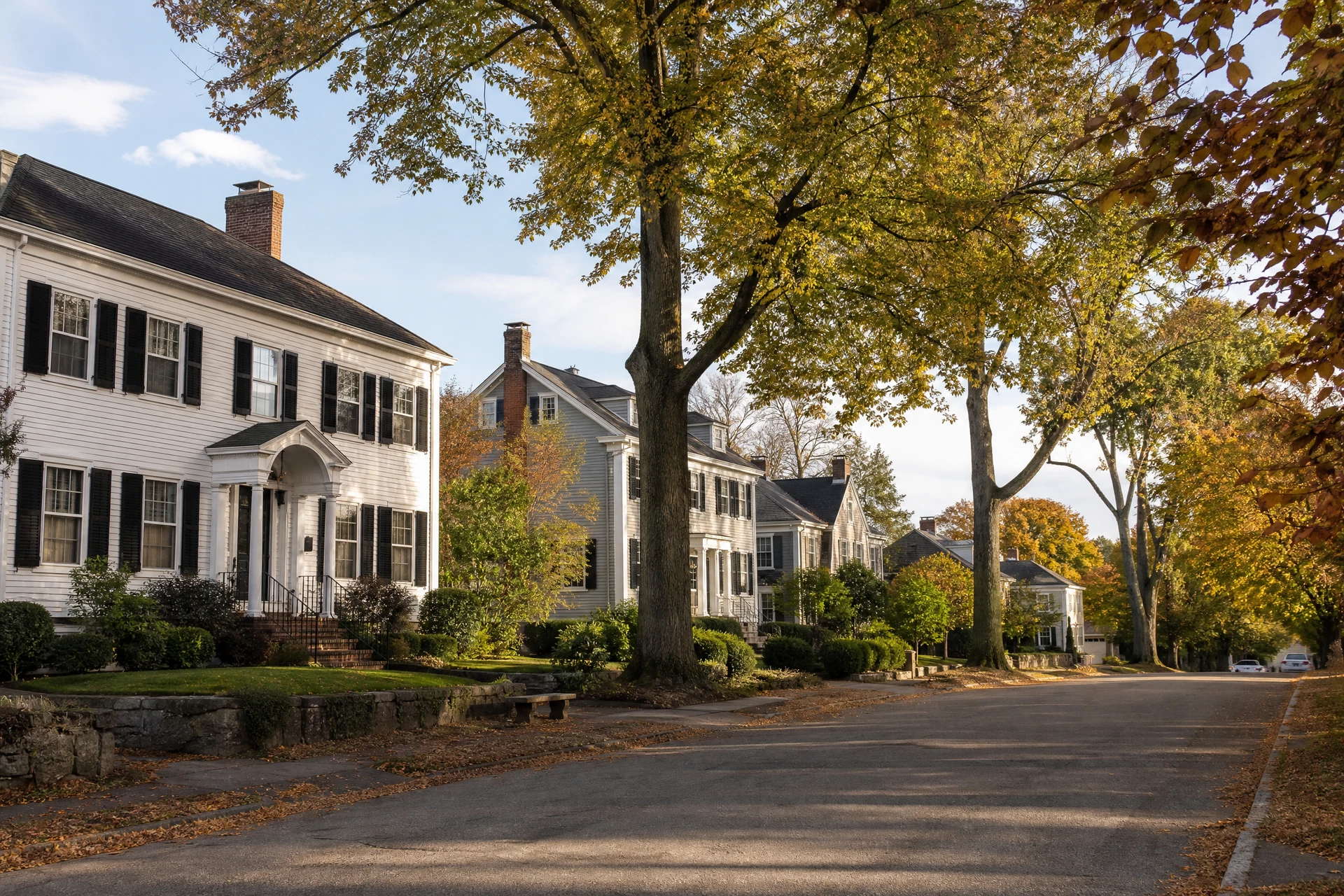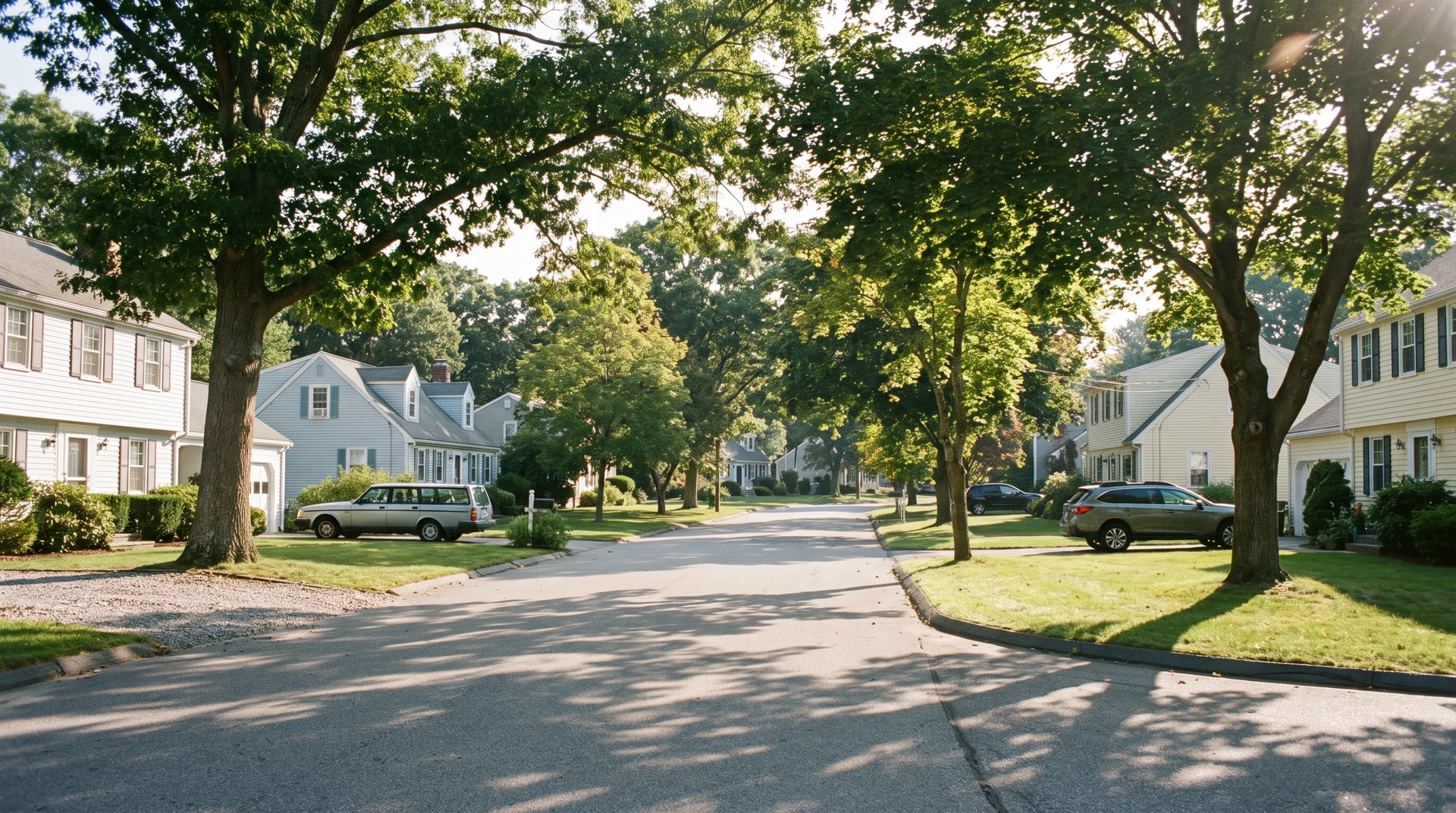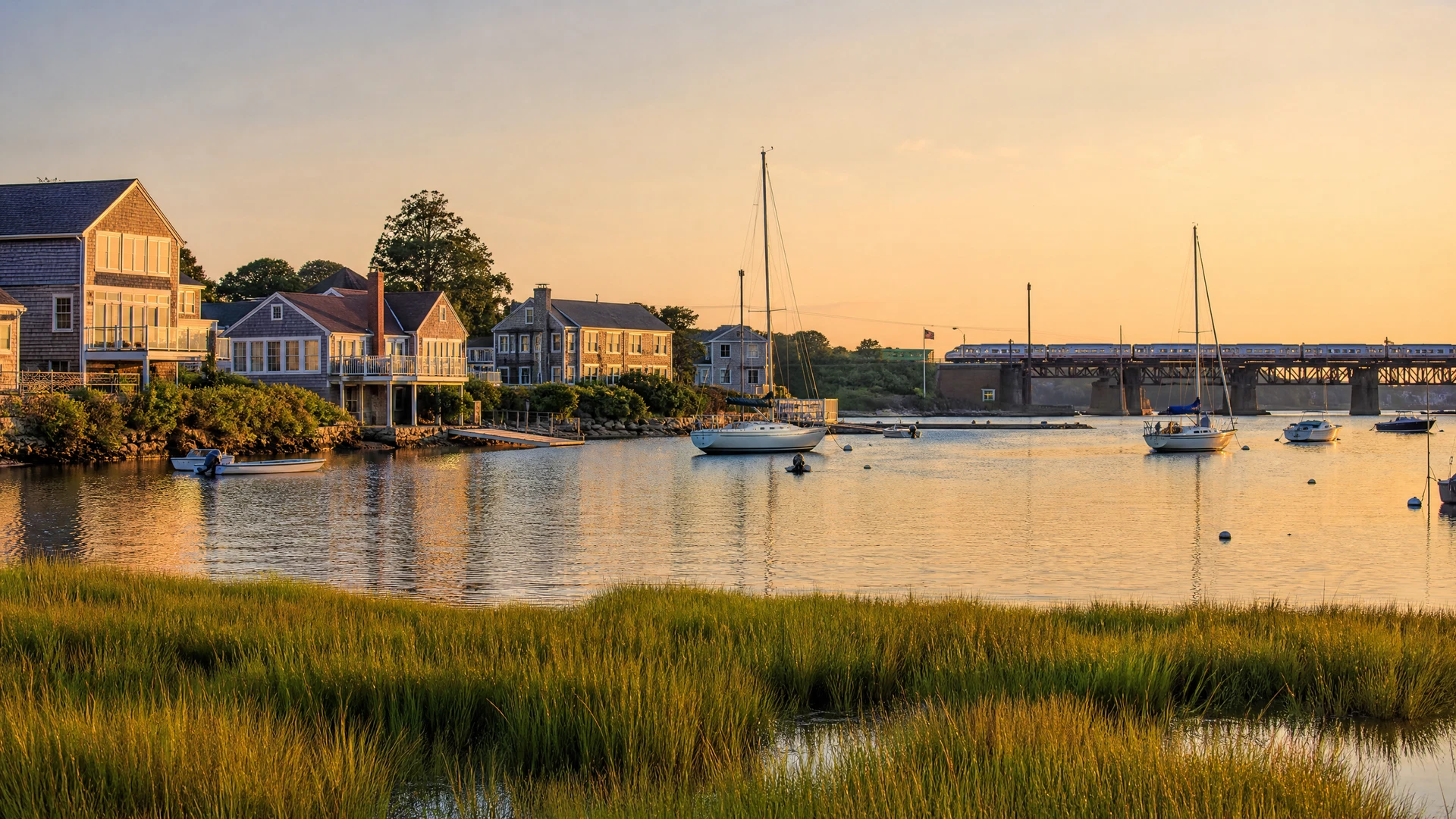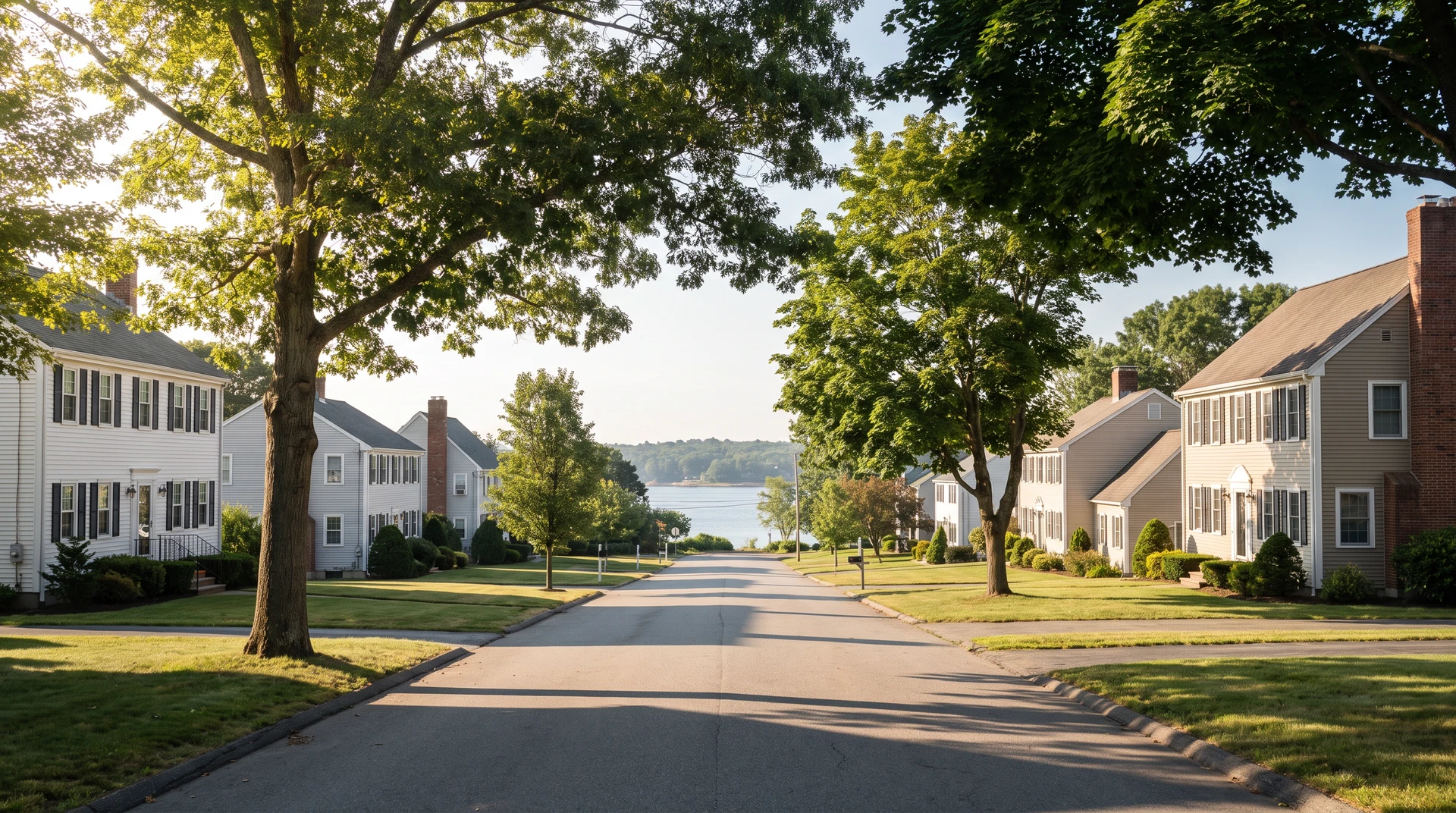
Weymouth has three commuter rail stations on two different lines, a residential tax rate of $10.12 per $1,000 of assessed value as certified for fiscal 2026, and median sale prices running in the high $500,000s to low $600,000s this year. What it does not have is rapid transit. If you want more house and a lower tax rate than Quincy or Milton and you are willing to ride a train instead of the Red Line, Weymouth is usually where the search lands.
That is the short version, and it is why Weymouth stays busy. The longer version is that Weymouth is four towns wearing one name. North Weymouth is coastal. East Weymouth is older and denser. South Weymouth is suburban and sits next to the largest redevelopment site in Massachusetts. Weymouth Landing is a walkable village center on the Braintree line. Buying in one of them tells you very little about what buying in another would have cost or felt like.
Who this applies to
This is for the buyer who priced out of Hingham or Milton and wants to know what the next town over actually buys. It is for the commuter who has accepted that a train schedule, rather than a subway that comes every few minutes, is the trade they are making. It is for the family that needs a fourth bedroom and a yard inside a $600,000 to $700,000 budget on the South Shore. It is for investors looking at two and three families in East Weymouth and the Landing. And it is for the family selling a parent's house here, which is a large share of what actually trades in this town.
If you need to be on rapid transit, or you want a dense walkable downtown with restaurants at the end of the block, Weymouth will frustrate you. It is a large, spread-out suburb with several small centers rather than one big one.
What Weymouth actually is
Weymouth sits in Norfolk County on Hingham Bay, roughly 12 miles southeast of downtown Boston, with about 57,400 people at the 2020 census and an estimate near 60,200 as of 2024. It covers about 21.6 square miles, nearly 5 of which are water, and it borders Quincy, Braintree, Holbrook, Abington, Rockland, and Hingham.
It is still officially the Town of Weymouth, and it has not run on town meeting since the 1990s. Voters approved a change to a mayor and council government in 1999, and the first mayor took office in 2000. Weymouth is one of a small group of Massachusetts municipalities that operate as cities while keeping "Town of" in the official name. In practice that means an elected mayor, an eleven-member council, and a permitting process that runs through city-style departments rather than volunteer boards.
The housing stock is genuinely mixed, which is unusual for a town this size. You will find 1890s and early 1900s homes near the older village centers, dense postwar capes and ranches, 1960s splits, two and three families concentrated in East Weymouth and the Landing, waterfront and near-water cottages in North Weymouth that have been expanded over decades, and newer condo and townhouse product on the Route 18 and Route 3A corridors. Most of the town predates 1978, so lead paint, older systems, knob and tube remnants, and buried oil tanks are all live diligence items here rather than theoretical ones.
South Shore Health, anchored by South Shore Hospital in South Weymouth, is the largest health care employer on the South Shore and a significant part of the town's daytime population and employment base. That matters to an investor thinking about rental demand more than it matters to a family buying a colonial.
Getting into Boston from Weymouth
Weymouth has no subway station. The nearest rapid transit is Braintree station, the southern terminus of the Red Line's Braintree branch, one town over. A lot of Weymouth residents drive there and park in the garage, which is a real commute strategy and also a real daily cost and a real competition for spaces.
What Weymouth does have is three commuter rail stations, more than most towns its size:
1. Weymouth Landing/East Braintree, on the Greenbush Line, at 121 Commercial Street in Weymouth, right at the Braintree line. It serves both towns, and it is the station for the Landing and the northwest corner of Weymouth.
2. East Weymouth, on the Greenbush Line, at 1590 Commercial Street. It is fully accessible and sits near Jackson Square, the East Weymouth village center.
3. South Weymouth, on the Kingston Line, at 89 Trotter Road. It opened in 1997 with the Plymouth and Kingston service and it is the station closest to Columbian Square and to Union Point.
The distinction people miss is that these are two different lines going to South Station on two different schedules, and neither runs like a subway. Greenbush and Kingston trains come at commuter frequencies, not every few minutes, and that gap defines your evening. Pull up the actual schedule for the specific station you would use and look at the last train home before you decide what a house near it is worth.
Driving, the town is organized around Route 3, Route 3A along the water, Route 18 running north to south through the middle, and Routes 53, 58, and 139. Route 3A crosses into Quincy on the Fore River Bridge, a vertical lift bridge that opens for marine traffic, which is a fact worth internalizing if your commute depends on it. Route 3 to the Braintree Split gets you to I-93 and Route 128, and it is reliably slow at rush hour in both directions.
The villages, and what each one trades
| Village | What it feels like | Commute setup | Who it usually fits |
|---|---|---|---|
| North Weymouth | Coastal, near Wessagusset Beach and the Fore River, a mix of expanded cottages and year-round homes | Route 3A over the Fore River Bridge into Quincy, bus service, no station in the village | Buyers who want water access on the South Shore under Hingham prices, and who will actually price flood insurance first |
| Weymouth Landing | The most walkable village center, shops and restaurants, recent condo and mixed-use redevelopment | Weymouth Landing/East Braintree on the Greenbush Line, short drive to Braintree station for the Red Line | Commuters and downsizers who want to walk to coffee and a train without paying Quincy Center prices |
| East Weymouth | Older and denser, centered on Jackson Square, the heaviest concentration of two and three families | East Weymouth on the Greenbush Line | Investors, house hackers, and first-time buyers looking for the lowest entry point in town |
| South Weymouth | Suburban single family streets, wider lots and driveways, centered on Columbian Square | South Weymouth on the Kingston Line, Route 3 access | Families who want a yard and a school-run radius, and who are fine driving to everything else |
| Weymouth Heights and the Idlewell area | Older, quieter pockets on the north side with some of the town's oldest housing | Drive to Route 3A or the Landing station | Buyers who want character and are prepared for an older home's systems |
Two honest caveats on that table. Village boundaries in Weymouth are informal and residents disagree about exactly where one ends and the next begins, so treat this as orientation rather than lines on a map. And the price spread inside any one village is wide enough that the specific street matters more than the label, so a renovated colonial on a quiet East Weymouth street can easily outsell a tired ranch in South Weymouth.
What homes cost, and what your tax bill actually looks like
Median sale prices in Weymouth have been running in the high $500,000s to low $600,000s through 2026, up modestly from a year earlier, which tracks the broader South Shore pattern of firm to rising prices on tight inventory. Treat that as a center of gravity, not a price. It moves month to month and it shifts with the mix of what happened to sell, so a month where three waterfront homes close will read very differently from a month of condos. Condos and smaller capes sit well below it, and renovated single families in South Weymouth and near the water sit well above.
The tax picture is more concrete, and it is one of the real reasons buyers land here. As certified for fiscal 2026, Weymouth's rates are:
| Class | Fiscal 2026 rate per $1,000 of assessed value |
|---|---|
| Residential | $10.12 |
| Commercial, industrial, and personal property | $15.85 |
Weymouth uses a classified, or split, rate. For fiscal 2026 the town council approved a shift of 146% onto commercial, industrial, and personal property, which is what holds the residential rate where it is. Fiscal 2025 was $10.10 residential and $15.97 commercial, so the residential rate has been close to flat while the commercial rate came down slightly.
Here is the part people skip. Your bill is the rate multiplied by your assessment, so a low rate on a high assessment is not a low bill. Two houses on the same street with the same rate can have very different tax bills, and a recent sale often moves an assessment. Before you get attached to the rate, pull the actual assessed value for the specific property, multiply it by $10.12 per $1,000, and look at that number. Also ask whether the seller has an exemption on the account, because a senior or veteran exemption belongs to the person, not the house, and it disappears at closing.
One more line item most buyers do not see coming. Weymouth adopted the Community Preservation Act in November 2005 and charges a 1% surcharge on the property tax, with the first $100,000 of residential assessed value exempt and an additional exemption for income-qualified households. It is small, and it is on the bill, so include it when you compare a Weymouth bill against a town without CPA.
Figures in this section were checked against the Weymouth assessors' certified fiscal 2026 tax rates and South Shore market reporting in August 2026. Tax rates are certified annually and sale price medians move monthly, so confirm both before you rely on them.
The water story nobody tells buyers
This is the Weymouth fact that almost never comes up on a showing, and it should.
Weymouth does not buy its water from the MWRA the way Quincy and much of Greater Boston does. The town runs its own water department, drawing from Great Pond and a set of groundwater wells, serving roughly 55,000 people through more than 16,000 service connections. Its permitted withdrawal is 5 million gallons a day, and the town has dealt with intermittent shortages and outdoor water bans going back to the 1960s. Town planning documents have projected that demand could reach the withdrawal limit within a few years once the redevelopment of the former naval air station is factored in.
That is why Weymouth is building a connection to the MWRA. A pipeline of roughly 6.7 miles is in the permitting and design phase, with more than $35 million in state and local infrastructure funding already secured, design targeted for 2028, and total project completion targeted for 2031. Officials have said the intent is that town taxpayers do not carry the construction cost.
For a buyer, the practical takeaways are simple. Expect the possibility of summer outdoor watering restrictions and ask what last summer's rules actually were, especially if the yard or the irrigation system is part of why you like the house. Ask about the water and sewer bill directly, because in Weymouth it is a town utility with its own rate structure rather than a line you can predict from a neighboring town. And understand that water rates are likely to change over the next several years as this project moves, in either direction, so do not build a ten-year budget on today's number.
Union Point, and why it is suddenly a live issue again
The former South Weymouth Naval Air Station closed in 1996 and has spent nearly three decades as the most-discussed and least-built piece of land on the South Shore. That changed in July 2026, when Washington Capital Management sold its land there to a joint venture of Brookfield Properties and New England Development for $65 million.
The site spans more than 1,400 acres across Weymouth, Rockland, and Abington. The new owners have proposed a mixed-use redevelopment of about 6,500 housing units and roughly two million square feet of commercial and retail space, with more than 880 acres preserved as open space. Infrastructure work has been expected to begin in fall 2026. Projected net new annual tax revenue across the three towns runs to nearly $24 million, of which roughly $14 million would go to Weymouth and about $5 million each to Rockland and Abington. The MWRA water pipeline described above is part of the same infrastructure picture.
Read that with the town's history in mind. This site has been announced, master planned, rebranded, and stalled repeatedly since the base closed, and a purchase and a proposal are not a built neighborhood. What has actually changed is the balance sheet behind it, and that is a meaningful change rather than another press release.
For a buyer, the question is not whether to believe the unit count. It is whether you want to own within a few minutes of a site that will be under construction for years and will eventually add thousands of households, with the traffic, the school enrollment, the retail, and the demand that comes with all of it. South Weymouth and the Route 18 corridor sit closest to it. Some buyers should want that exposure. Some should not, and the honest answer depends on how long you plan to own.
What else is changing here
Weymouth is an MBTA community subject to Section 3A of M.G.L. c. 40A, the multifamily zoning law, which requires communities served by the MBTA to zone at least one district of reasonable size where multifamily housing is allowed as of right. As of late January 2026, the state listed twelve municipalities as noncompliant, and Weymouth was not among them. Ask the planning department where the overlay sits relative to a property you are considering, because near a station that zoning is what shapes the next decade of what gets built next door.
Separately, the town council unanimously passed an accessory dwelling unit ordinance on February 3, 2025, as Measure 24-119, implementing the state's Affordable Homes Act provision that made ADUs allowable as of right in single family zones statewide effective February 2, 2025. If you are buying with an in-law situation in mind, or thinking about adding rental income to a single family later, that is the ordinance to read, and its local size, parking, and permitting details are the ones that will actually govern your project.
Six things to check before you make an offer in Weymouth
1. Ride the actual train, not the map version. Walk from the property to the specific station you would use, check whether there are sidewalks the whole way, and look at the last train home on that line's real schedule. Greenbush and Kingston run on different timetables and neither behaves like the Red Line.
2. Price flood insurance before you commit, especially anywhere in North Weymouth or near the Fore River, the Back River, or Hingham Bay. Massachusetts has no state law requiring a seller to disclose flood zone status or a history of flooding, so this one is entirely on you. A seller does have to answer honestly if you ask directly, so ask in writing, then verify it yourself against the FEMA map and a real insurance quote, not an estimate.
3. Ask about water and sewer, not just taxes. Get twelve months of bills, ask what the outdoor watering restrictions were last summer, and understand that Weymouth is on its own supply until the MWRA connection is finished.
4. Read the assessment, not just the rate. Pull the property's assessed value, multiply by $10.12 per $1,000, add the 1% CPA surcharge net of the first $100,000 of value, and look at that number instead of the town average. Then confirm whether any exemption on the account belongs to the current owner.
5. Look at what is entitled nearby, particularly on the Route 18 and Route 3A corridors and anywhere within reach of Union Point or a station overlay. A quiet street today can sit next to a permitted project you never asked about.
6. Do the older-home diligence properly. Pre-1978 means lead paint rules apply, and Weymouth's stock is old enough that oil tanks, dated electrical, and original sewer laterals show up regularly. Budget for the inspection you actually need rather than the cheapest one available.
How Weymouth compares to the towns buyers weigh it against
| Town | Rapid transit | Commuter rail | Fiscal 2026 residential rate per $1,000 | Where it generally sits on price versus Weymouth | The trade-off |
|---|---|---|---|---|---|
| Weymouth | None in town, Red Line at Braintree station one town over | Three stations: Weymouth Landing/East Braintree and East Weymouth on Greenbush, South Weymouth on the Kingston Line | $10.12 | Baseline, median running in the high $500,000s to low $600,000s | Large and spread out, no rapid transit, coastal flood exposure on the north end, town water supply |
| Braintree | Red Line terminus at Braintree station | Kingston and Fall River/New Bedford at Braintree, Greenbush at Weymouth Landing/East Braintree | $10.06 | Generally above | Rapid transit and a municipal electric utility, but highway noise near the Split and less inventory |
| Quincy | Four Red Line stops | Greenbush, Kingston, and Fall River/New Bedford at Quincy Center | $11.78 | Comparable, varies widely by neighborhood and property type | More urban and walkable, higher tax rate, much denser |
| Hingham | None | Greenbush Line, plus the commuter boat to Boston | $10.47, a single rate applied to all classes | Generally well above | Coastal and historic with a strong school reputation, at a different price tier entirely |
| Milton | Mattapan trolley stops in town, connecting to the Red Line at Ashmont | None in town | $11.81 | Generally above | Closer in and highly regarded schools, tighter inventory, higher tax rate |
Two notes on reading that table. The price positions are directional, not fixed, and the gaps move year to year and by property type. And a lower rate does not automatically mean a lower bill, because assessments differ town to town, so run the math on the actual property in each town you are comparing.
Tax rates in this table are the certified fiscal 2026 rates from each town's assessor, checked in August 2026. One caution worth knowing: a lot of what circulates online is the prior fiscal year's rate presented as current. Braintree was $9.98 in fiscal 2025 and $10.06 in fiscal 2026, Hingham was $10.69 and then $10.47, Weymouth was $10.10 and then $10.12. If a number you find does not say which fiscal year it belongs to, assume it is stale and check the assessor's page.
A note on schools
Weymouth runs one high school, Weymouth High School, with roughly 1,700 students, and one middle school, the Maria Weston Chapman Middle School, which opened in September 2022 at a cost of about $163 million and consolidated the town's two former middle schools into a single 252,000 square foot building serving grades 6 through 8.
That structure is worth knowing before you buy, because it means the middle school and high school experience is the same across the whole town. In Weymouth your school decision is not a neighborhood decision the way it is in a town with multiple middle schools, and the elementary assignment is the only piece that varies by where you live. Confirm the current assignment for a specific address with the district rather than assuming, since boundaries do change.
One note if you are selling an inherited home here
Weymouth is in Norfolk County, so an estate here goes through the Norfolk Probate and Family Court in Canton, and the deed records sit at the Norfolk County Registry of Deeds in Dedham. That is a different court and a different registry from a Plymouth County town like Hingham, Rockland, or Marshfield, which matters for timing, because the practical pace of getting a personal representative appointed varies by county.
Inherited property is a large share of what actually comes to market in Weymouth, and a lot of it is the long-held family home that has not been updated in thirty years. If that is your situation, sort out the appointment and your authority to sell before you start scheduling contractors or accepting an offer. The order matters, and getting it backwards costs weeks.
The bottom line
Weymouth buys you three commuter rail stations, a residential tax rate of $10.12 per $1,000, real coastline, and more house than Milton or Hingham at a median that has been running in the high $500,000s to low $600,000s. For a commuter who can live with a train schedule, that is a strong package, and it is why the town competes well against neighbors that cost more.
What you give up is rapid transit and a single walkable center. What you take on is a town in the middle of two large changes, a water system moving to the MWRA and 1,400 acres at the old naval air station finally under new ownership. Neither is a reason to avoid Weymouth. Both are reasons to buy in the part of it that fits how long you actually plan to stay, because in Weymouth the village decision is the real one.
FAQ
Common questions, answered.
Does Weymouth, MA have a train to Boston?
Yes, three commuter rail stations, but no subway. Weymouth Landing/East Braintree and East Weymouth are on the Greenbush Line, and South Weymouth is on the Kingston Line, all running to South Station. The nearest rapid transit is Braintree station on the Red Line, one town over, which many Weymouth residents drive to and park at. Check the actual timetable for your station, because commuter rail frequency is nothing like the Red Line.
What is the property tax rate in Weymouth, MA?
As certified for fiscal 2026, the residential rate is $10.12 per $1,000 of assessed value, with commercial, industrial, and personal property at $15.85. Weymouth uses a split rate, with a 146% shift onto the commercial classes for fiscal 2026, which is what keeps the residential rate low. There is also a 1% Community Preservation Act surcharge on the bill, exempting the first $100,000 of residential assessed value, and your actual bill is the rate multiplied by your specific assessment.
Is Weymouth cheaper than Braintree or Hingham?
Compared with Hingham, generally yes, and by a wide margin, since Hingham sits in a higher price tier. Compared with Braintree it is closer, and Weymouth usually prices somewhat below Braintree, largely because Braintree has the Red Line and Weymouth does not. Braintree's fiscal 2026 residential rate of $10.06 is actually a touch lower than Weymouth's $10.12, so the savings in Weymouth show up in the purchase price rather than in the tax rate.
What is happening at Union Point in Weymouth?
The former South Weymouth Naval Air Station, more than 1,400 acres across Weymouth, Rockland, and Abington, was sold in July 2026 to a joint venture of Brookfield Properties and New England Development for $65 million. The proposal is roughly 6,500 housing units and about two million square feet of commercial space, with more than 880 acres kept as open space, infrastructure work expected to start in fall 2026, and projected net new tax revenue of roughly $14 million a year to Weymouth alone. It is tied to Weymouth's separate project to connect its water system to the MWRA, targeted for completion in 2031, since the town's current supply from Great Pond and its wells is close to its permitted withdrawal limit.
Monthly Market Recap
Get the Greater Boston market recap, once a month.
Prices, inventory, and what it actually means for buyers and sellers around Quincy and the South Shore.