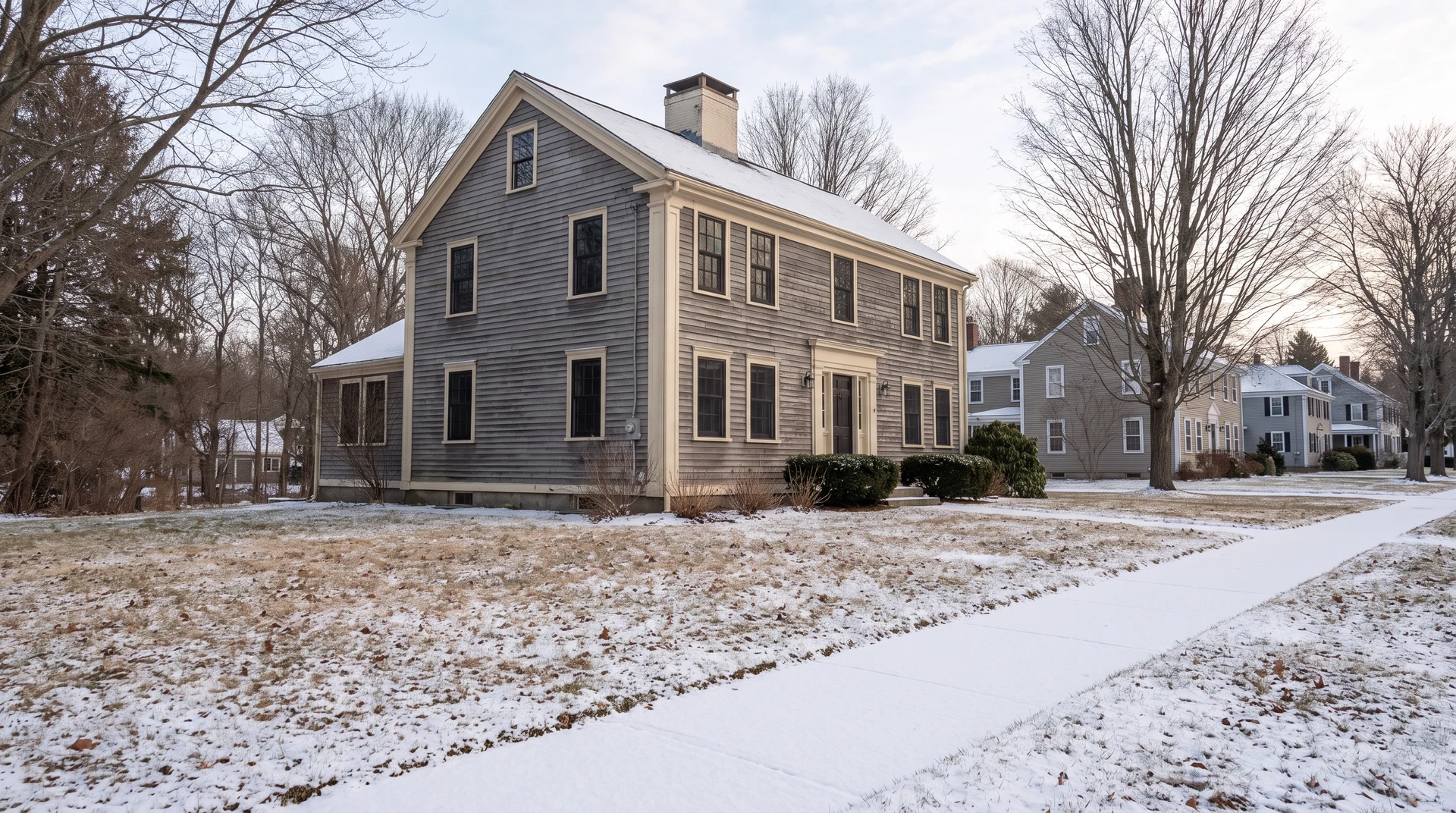
There are four real options for an inherited house, and in almost every family I sit with, the decision comes down to a single question: can the heirs who want to keep the house afford to pay the heirs who do not. Sentiment is what people argue about. Liquidity is what actually decides it.
Here is the fact that sets the floor under every one of these conversations. Under Massachusetts General Laws chapter 241, any co-owner of a property can petition for partition in the Probate and Family Court or the Land Court, and if the house cannot be physically divided, which a single-family house essentially never can, section 31 lets the court order it sold and the proceeds divided. No heir can be forced to stay a co-owner of a house they want out of. That is worth knowing on day one, because it changes the tone of the negotiation. The question is never whether the reluctant heir can be overruled. It is whether the family settles this themselves or pays a court to do it for them.
This is Step R of the Inherited with Clarity Method, review every option. It comes after you have added up the real numbers, because you cannot compare four options until you know what the house actually nets.
Who this applies to
You and one or more siblings, cousins, or a surviving parent have inherited a house, or you are the personal representative and the heirs are looking at you to frame the choice. Probate may be open or it may not. Somebody wants to keep it. Somebody wants to cash out. Somebody has floated renting it as a compromise. Nobody has put numbers next to any of those yet, and the house is costing money every month while you talk. If you are still earlier than this, the ground rules are on my inherited and probate property page.
The four options, side by side
The figures in this post are mechanics and rates rather than prices. The tax figures were checked against Massachusetts Department of Revenue and IRS guidance in September 2026, and the statutory citations against the General Laws on malegislature.gov the same month.
| Option | What it takes | Best when | The catch |
|---|---|---|---|
| Sell on the open market | Clear title, authority to sign, and a house presentable enough to list | Heirs live apart, want different amounts of money, or nobody wants to manage a property | Takes roughly two to four months from list to closing, and the estate carries every cost until it closes |
| One heir buys out the others | Cash or financing equal to the other heirs' combined share, plus an agreed value | One heir genuinely wants the house and can qualify for a loan on it | The buying heir needs the full value of everyone else's share, not just a down payment |
| Rent it out | A house in lettable condition, landlord insurance, and someone local to manage it | The house needs no major work, the rent covers carrying costs, and no heir needs the money now | Every heir is now a landlord and still a co-owner, and chapter 186 section 15B punishes amateurs |
| Keep it as a family property | A written agreement on who pays what, who decides what, and how an owner exits | A vacation house or a multi-family with genuine shared use, and heirs who get along | Carrying costs never stop, and the step-up in basis stops protecting you the day after death |
Option one, selling
Selling is the only option that ends the co-ownership cleanly and converts the asset into something divisible. It is also the default, in the sense that it is what happens if the family cannot agree on anything else.
The thing to understand about selling an inherited house is that the tax picture is usually far friendlier than families expect, and it is at its friendliest right now. Federal law generally steps the property's cost basis up to its fair market value on the date of death. Sell near that value and there is little or no taxable gain, regardless of what the person who died originally paid for it. A house bought in 1974 for $38,000 and worth $700,000 today does not generate $662,000 of taxable gain if the estate sells it promptly. That is the single largest tax advantage in this entire decision, and it is the one that quietly erodes if you hold.
If you want the full arithmetic of what a sale actually leaves after payoffs, selling costs and carrying costs, I walk through it line by line in what an inherited house actually nets after costs. And if someone has already put an as-is cash number in front of the family, run it against the open market properly before anyone accepts it, which is the comparison in cash offer versus listing.
Option two, one heir buys out the others
This is the option families most often assume is simple and most often get wrong, because they confuse a buyout with a down payment. If a house is worth $600,000, is owned free and clear, and three siblings inherit it equally, the sibling keeping it does not need $200,000. They need $400,000, which is the combined value of the other two shares. That is the number that stops most buyouts, and it is better to find that out in week one than in month four.
Here is the sequence that works:
- Agree on a value, and agree on how you got it. A licensed appraisal is the cleanest, because it is a number none of you chose. A broker price opinion or a CMA is faster and cheaper, and it is usually enough when everyone is on reasonable terms. Whatever you pick, pick it before anyone states a preference, not after.
- Subtract what comes off the top. Any mortgage balance, home equity line, tax lien, or recorded municipal charge reduces the equity being divided. Divide net equity, never the sale price.
- Decide whether to subtract a selling-cost allowance. The heir keeping the house is not paying a broker fee or the deed excise, so some families deduct a notional allowance, commonly somewhere in the 5 to 8 percent range, so the buyout reflects what a sale would really have netted. It is a convention rather than a rule, it is entirely negotiable, and the only wrong answer is leaving it unsaid.
- Confirm the buying heir can actually finance it. This is the step that gets skipped. They should talk to a lender before anyone shakes hands, because qualifying to buy out co-heirs is not identical to qualifying for an ordinary purchase.
- Paper it properly. The buying heir takes title by a deed from the estate or from the other heirs, the selling heirs are paid at that closing, and everyone signs a release. Use a real estate attorney. A family agreement that lives only in a group text is not a conveyance.
Two financing points that save real money here, and most heirs never think to ask about either. First, the federal Garn-St Germain Act generally prevents a lender from calling a mortgage due when a relative inherits a home, on residential property of fewer than five units, so an existing low-rate mortgage does not automatically have to be paid off just because the owner died. Second, under Fannie Mae's guidelines a refinance whose purpose is buying out a co-owner is treated as a limited cash-out refinance rather than a cash-out refinance, which is usually priced better, and the normal requirement that the owners held the property jointly for twelve months is waived when the lender documents that the borrower acquired it by inheritance. That last point matters, because it means a buyout does not have to wait a year. The guidelines do require all parties to sign a written agreement setting out the terms of the transfer and what happens to the loan proceeds, so build that into the plan rather than bolting it on at closing.
Option three, renting it out
Renting sounds like the compromise that gives everyone what they want. Sometimes it is. More often it converts a one-time disagreement into a recurring one.
Run it as an investment, not as a way to avoid a decision. That means the rent has to cover the mortgage if any, taxes, insurance, water and sewer, maintenance, a vacancy allowance and management, and still leave something. Landlord insurance costs more than a homeowner policy. An older house that was fine for an owner who tolerated its quirks is a different proposition once a tenant is entitled to a habitable unit.
Two Massachusetts specifics catch new landlords. Security deposits are governed by chapter 186, section 15B, and it is one of the strictest deposit statutes in the country: the deposit must sit in a separate interest-bearing account at a bank located in Massachusetts and beyond the reach of the landlord's creditors, it earns 5 percent a year or the bank's rate if lower and that interest is paid to the tenant annually, the tenant gets a receipt naming the bank and a written statement of the unit's condition, and getting any of it wrong can cost three times the deposit plus court costs and the tenant's attorney fees. This is not a statute to learn by doing.
The second point is the opposite of what most families assume. If probate is open, the personal representative generally does have the power to lease. Chapter 190B, section 3-715 expressly authorizes a personal representative to enter into a lease as lessor, for a term within or even extending beyond the period of administration, provided they act reasonably for the benefit of the interested persons and the will or a court order in a formal proceeding has not restricted it. The genuine catches are narrower: a special personal representative does not have that power, and a tenant with a lease in place will constrain how and when you can sell later. Know which one you are before you sign anything.
There is also a timing trap worth naming. Converting the house to a rental starts depreciation, which lowers your basis over time and is recaptured when you eventually sell, at a federal rate of up to 25 percent on the recaptured portion. Renting for a year while you get organized is usually harmless. Renting for eight years changes the math on the eventual sale meaningfully.
Option four, keeping it
Keeping a house jointly is the right answer more often than people in my business admit, particularly for a Cape house, a lake place, or a multi-family where one heir already lives in a unit. It is the wrong answer when it is chosen by default because deciding felt disloyal.
If you keep it, write down four things before the first bill arrives: who pays the carrying costs and in what proportion, who is allowed to make spending decisions and up to what dollar amount, what happens if one owner stops paying, and how an owner exits if they want out later. That last one is the one nobody writes and everybody needs. Without a written buy-sell mechanism, the only exit is a partition action, which is expensive, slow and public.
Also be honest about the clock. The step-up in basis fixed your cost basis on the date of death. Every year of appreciation after that date is potentially taxable gain when you eventually sell. In a market like Greater Boston, holding a house for a decade can generate a six-figure taxable gain that would not have existed had the estate sold it promptly. That is not a reason to sell. It is a cost of keeping, and it belongs in the comparison alongside the mortgage and the tax bill.
Massachusetts taxes most long-term capital gain at a flat 5%, and gain on property acquired from someone who has died is treated as long-term regardless of how briefly you held it. Massachusetts also applies a 4% surtax on annual taxable income above $1,107,750 for tax year 2026, a threshold adjusted each year, and a large one-time gain can push an otherwise ordinary year over it. That surprises people who do not think of themselves as high earners.
What happens if you cannot agree
You end up in a partition action under chapter 241. A co-owner petitions the Probate and Family Court or the Land Court, the court appoints commissioners, and because a house cannot be cut in half, the case proceeds to a partition by sale under section 31. The proceeds are divided after costs and fees are paid.
I am not an attorney and none of this is legal advice, but I will tell you what I have watched happen: a partition sale almost always nets less than a properly marketed sale, and the legal fees come out of everyone's share, including the share of the heir who did not want the fight. The threat of partition is often useful. Actually filing one is usually the most expensive way to reach the outcome the family could have reached themselves.
If your situation is specifically one heir wanting to sell and the others resisting, that standoff has its own playbook in what happens when siblings inherit a house and one wants to sell.
How long do you actually have to decide
Longer than the family pressure suggests, and shorter than the carrying costs allow.
There is no statutory deadline forcing you to sell an inherited house in Massachusetts. What creates the real deadline is money leaving the estate every month: property taxes, insurance at vacancy rates if nobody is living there, utilities kept on for heat and to prevent frozen pipes, and any mortgage still being paid. If the estate is large enough to be taxable, a Massachusetts estate tax return is generally due nine months after the date of death, which puts a hard date on the tax side even though the house itself has none.
My honest advice is to give the decision a deadline of your own choosing, usually sixty to ninety days, and to spend that window getting a value, a payoff figure, and a lender conversation rather than relitigating what your mother would have wanted. Families that set a date decide. Families that do not are still paying the oil bill in February.
The bottom line
Four options, one gating question: can whoever wants the house pay whoever does not. If yes, a buyout is often the cleanest outcome, and it needs a real value, a real lender and a real attorney. If no, you are choosing between selling now and renting while you get organized, and selling now preserves the tax advantage that holding slowly spends. Keeping it jointly works, but only in writing.
Nobody can force a co-owner to stay in a house they want out of, and nobody should have to buy out a sibling with money they do not have. Get the number first. The decision is usually obvious once the number is on the table, and it is almost never obvious before.
FAQ
Common questions, answered.
Can my sibling force me to sell our inherited house in Massachusetts?
Effectively yes, by filing a petition for partition under chapter 241 in the Probate and Family Court or the Land Court. A single-family house cannot be physically divided, so the case proceeds to a partition by sale and the proceeds are split. That is why most families settle it themselves, since a partition sale typically nets less and the legal fees come out of everyone's share.
How do I calculate what it costs to buy out my siblings?
Take the agreed value, subtract any mortgage or liens to get net equity, then pay each other heir their fractional share of that equity. If the house is worth $600,000 free and clear and three siblings inherit equally, the one keeping it needs $400,000, not $200,000. Some families also deduct a selling-cost allowance so the buyout reflects what a real sale would have netted.
Do we have to pay off the mortgage when we inherit the house?
Usually not immediately. The federal Garn-St Germain Act generally bars a lender from calling the loan due because a relative inherited the property, on residential property of fewer than five units, so an existing mortgage can often stay in place while you decide. Payments still have to be made on time, and you should notify the servicer in writing that the borrower has died.
Is it better to sell right away or wait for the market?
Selling near the date of death usually carries the smallest tax bill, because the basis is stepped up to the date-of-death value and there is little gain to tax. Waiting exposes every dollar of appreciation after that date to capital gains tax, on top of the carrying costs of holding. Waiting can still be right if the house needs work that will pay for itself, but it should be a decision with a number behind it.
Monthly Market Recap
Get the Greater Boston market recap, once a month.
Prices, inventory, and what it actually means for buyers and sellers around Quincy and the South Shore.