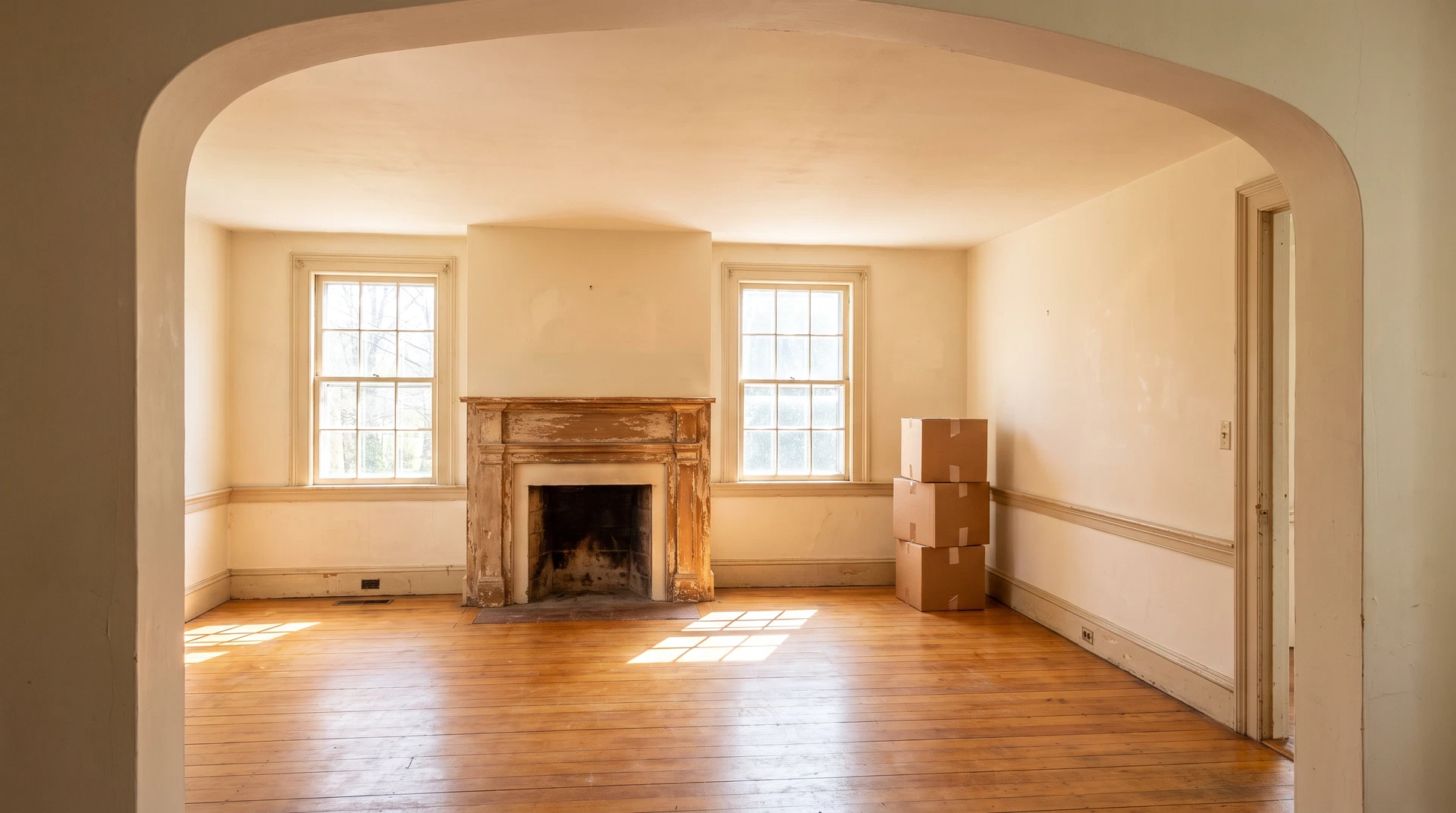
No. There is no Massachusetts law that requires you to empty an inherited house before you sell it. What creates that obligation is the paperwork you sign, the accepted offer, the purchase and sale agreement, or an addendum, and the two standard purchase and sale forms used in this state do not agree with each other on the point. One of them makes you remove the contents. The other one does not.
That gap is where most of the panic comes from. Families call me convinced there is a rule somewhere saying the house has to be empty before it can go on the market, and there is not. What there is instead is a short list of state requirements that have nothing to do with your parents' furniture, plus a contract term you get to negotiate before you sign anything.
Who this applies to
You are an heir or the personal representative of an estate, the house is in Massachusetts, and it still has a lifetime of belongings in it. Maybe you live an hour away and the thought of forty years of accumulation is what has kept you from calling anyone. Maybe you live in another state and cannot get here for more than a weekend. Either way, the decision in front of you is not legal. It is financial, and it has three real answers.
This is general information about how these sales work, not legal or tax advice. An estate attorney and your own accountant should sign off on the specifics of your situation.
What Massachusetts actually requires when you transfer a house
Here is the entire list of things the state cares about at a residential closing that people confuse with a cleanout requirement. Notice that only one line in this table is about the contents at all, and it is not a law.
| Requirement | When it applies | What it has to do with the contents |
|---|---|---|
| Smoke alarm certificate of compliance | Homes with 1 to 5 dwelling units built or modified before January 1, 1975, under M.G.L. c.148 s.26F | Nothing directly, but the inspector has to physically reach and test every required alarm. Extreme clutter can leave the inspection incomplete and the certificate unissued until the access is cleared, which is the one way a full house genuinely delays a closing |
| Carbon monoxide compliance | Checked on sale or transfer regardless of the year built or the unit count, under M.G.L. c.148 s.26F 1/2, though the underlying alarm requirement applies to homes with fossil fuel burning equipment or enclosed parking | Same access issue, nothing more. Certificates expire 60 days after issuance, so schedule the inspection close to the closing date rather than months ahead |
| Title 5 septic inspection | Homes on a private septic system, inspected at or within 2 years before the transfer, or 3 years with annual pumping records, under 310 CMR 15.301. Exceptions exist, including certain family and trust transfers and weather-delayed inspections | Nothing inside the house. The inspector needs access to the tank and the cover in the yard |
| Property transfer lead paint notification | Homes built before 1978 | Nothing. It is a disclosure package handed to the buyer, not a condition the house has to be in |
| Removing the contents | Only when the contract you sign says so | Everything. This is the only row on this list that is actually about the stuff, and it is a negotiated term rather than a statute you obey |
Figures and citations in this section were checked against the Massachusetts General Laws and 310 CMR 15.000 in August 2026. One practical note: many fire departments run a single combined inspection and issue one certificate covering both alarm types rather than two separate ones.
The contract term that actually decides this
Two standard forms circulate in Greater Boston, and on this specific question they say different things.
The Massachusetts Association of Realtors standard form says the seller gives the buyer possession of the premises free of all occupants and of all personal property, except property included in the sale, and that the premises will be broom clean at the time for performance. If you sign that form unmodified, you have agreed to empty the house.
The Greater Boston Real Estate Board standard form is narrower. It obligates the seller to deliver the property free of tenants and occupants and in the same condition it was in when the agreement was signed, and it does not carry the same personal property removal and broom clean language.
Both are standard forms rather than required ones, and either can be changed by addendum, which is the part that matters to you. So the honest answer to "do I have to clean it out" is: read what you are actually signing, check which form it is and what the addenda say, and if you do not want to clear the house, put that in writing before you sign rather than after. Selling a house with the contents in place is completely normal in this state. It just has to be in the agreement, because a buyer who expected an empty house and walks into a full one at the final walkthrough has a real problem with you 24 hours before closing.
Broom clean, for what it is worth, is a low bar. It means personal items and debris removed and floors swept. It does not mean professionally cleaned, and it does not mean you owe anyone a spotless house.
Before anything leaves the house
This is the part that is genuinely specific to an inherited property, and it is the part people get wrong in the first week, usually with the best intentions. The contents that belonged to the decedent are generally estate assets, and the personal representative has a duty to safeguard and account for them. Until the estate says otherwise, they are not yours to give away, even if nobody else wants them.
Do it in this order:
- Confirm who has authority. Nobody should be removing, selling, or donating anything until a personal representative has been appointed. That is a separate question from whether you have authority to sell the real estate itself, which runs on its own rules and often surprises families. Property that passes outside probate, such as jointly held assets or anything in a trust, follows its own path and may not be the personal representative's to handle at all.
- Read the will for specific bequests. If the will leaves a named item to a named person, the ring or the dining set or the tools, that item is spoken for and should not go into an estate sale without the personal representative taking legal advice first, since estate debts and expenses can occasionally reach even specifically left property. This is the single most common way a cleanout turns into a family fight.
- Tell the other heirs before the truck comes. Give everyone a written window to walk through and claim what matters to them. A week is usually enough, and the email you send creates the record that you offered.
- Search before you sort. Cash, savings bonds, jewelry, deeds, insurance policies, and titles turn up inside books, coat pockets, freezers, and mattresses in these houses with a frequency that stops being funny. Nothing goes in a dumpster unopened.
- Set aside the paperwork. Tax returns, bank statements, medical records, and anything with a Social Security number on it get boxed for the estate and shredded later, not tossed at the curb.
- Photograph the rooms before you empty them. Under M.G.L. c.190B s.3-706 a personal representative prepares an inventory of the decedent's property within 3 months of appointment, listing fair market value as of the date of death, and then either files it with the court or mails a copy to every interested person whose address is reasonably available. Photos taken before the house is cleared make that job, and any later question from an heir, considerably easier.
That sequence takes a phone call and a weekend. Skipping it is what produces the sibling who finds out in October that their mother's china went to Savers in August.
What each route actually nets you
There are three real options, and the right one depends far more on the volume of stuff and your distance from the house than on the house itself.
| What you do | What it costs you | How long it takes | What it does to the sale |
|---|---|---|---|
| Sell with the contents in place | Nothing out of pocket, and you give up whatever the contents were worth | Days. It is a contract term, not a project | Narrows the buyer pool substantially toward investors and cash buyers, and the offer will price in the cleanout plus a margin for the trouble |
| Clear it out to broom clean, sell nothing | Often $500 to $3,000 as a starting estimate for a small to average job, plus dumpster or haul fees. Large houses, full attics and basements, hazardous materials, difficult access, or true hoarding conditions run well above that | One to three days on site once it is scheduled | Meets the standard MAR delivery term and lets the house be photographed, listed, and shown to ordinary buyers |
| Estate sale or auction first, then clear the rest | Estate sale companies commonly take 30% to 50% of gross sales, with the higher end typical for smaller or labor-intensive estates, and many bill the leftover cleanout separately on top of that | Two to six weeks, counting sorting, pricing, and the sale itself | Same effect on the sale as broom clean, and you keep whatever the contents actually brought |
Those are planning estimates rather than quoted rates, checked against national cleanout and estate sale pricing surveys in August 2026, and Greater Boston labor and disposal costs generally run at the higher end of them. Get two written quotes before you commit to any of the three, and make each quote say plainly whether disposal and dumpster charges are included.
The comparison people expect to be close usually is not. Selling with the contents in place feels like the free option because no money leaves your hand, but you are paying for it in the offer price, and the discount an investor applies for a full house is reliably larger than what the cleanout would have cost you. That is the same arithmetic that runs through a cash offer versus an open market sale, and it is worth actually running both columns rather than assuming.
Where selling as-is with contents genuinely wins: the house needs significant work anyway and is heading to an investor regardless, the volume is extreme, or the family simply cannot take on the project. Those are real situations and there is no shame in any of them.
What is actually worth selling
Be realistic here, because the gap between what families expect and what the market pays is the most common disappointment in this whole process.
What tends to sell: tools, lawn and garden equipment, appliances in working order, mid-century and older solid wood furniture, sterling, coins, jewelry, firearms handled through a licensed dealer, musical instruments, and anything genuinely collectible.
What tends not to sell: china sets, crystal, most brown furniture from the 1980s and 1990s, upright pianos, exercise equipment, encyclopedias, and mattresses. An estate sale company may decline the job entirely if the house is mostly this category, and that decision tells you something useful about the contents.
Donations are worth doing for the right reasons, and the tax deduction is usually not the biggest one. If your claimed deduction for noncash contributions is more than $500 you file IRS Form 8283, and once the claimed deduction for a single item or a group of similar items exceeds $5,000 you generally need a qualified appraisal. Household goods rarely clear that bar, and they also have to be in good used condition or better to support a deduction at all. Donate because it is faster and easier than a dumpster, and treat any deduction as a bonus.
One thing that does work in your favor: property acquired from a decedent generally takes a basis equal to fair market value on the date of death under IRC section 1014, and that applies to the contents, not just the house. It is called a step-up, though it works in both directions and can be a step down when the date-of-death value is lower than what the decedent had in the item. In practice, selling the furniture almost never creates a taxable gain. Confirm it with your accountant, since an estate can elect an alternate valuation date in some situations, but it is rarely the problem families expect it to be.
Doing this from out of state
You do not need to be in the room. Estate sale companies, cleanout crews, and auction houses in Greater Boston all work with remote clients routinely, and the sequence is straightforward: a video walkthrough on your phone, written quotes, a signed scope of work, a key or lockbox handed to someone local, and photos of the empty rooms when the job is done.
Two things to insist on. Get the scope in writing, specifically whether the price includes hauling everything or only the items they think they can sell, because "we'll clear the rest" and "we'll clear the rest for a fee" sound identical on a phone call. And have someone you trust walk the house before you release final payment.
The rest of the remote seller playbook, including who can act locally for you, how showings and access work, and how you sign from another state, is in the post on selling a Massachusetts house from out of state after inheriting it.
While the house sits full, it also sits vacant, and that is a separate risk worth taking seriously. Many standard homeowners policies restrict particular losses, commonly vandalism, theft, water damage, and glass breakage, once a home has been vacant for a stated stretch, often 30 or 60 consecutive days. Terms differ by insurer, and vacant does not always mean the same thing as unoccupied in a given policy. Call the carrier before that clock runs out rather than after something happens, ask specifically about a vacancy endorsement or a vacant home policy, and get the answer in writing.
What to fix while you are in there
Almost nothing. An inherited house does not need a renovation to sell well, and the money families spend on the wrong improvements before listing is money they do not get back. The short version is that cleaning, decluttering, and small mechanical repairs return far more than a new kitchen does, which I go through in detail in which repairs to make before listing and which to skip.
The one thing worth doing while the crew is already there: have them leave the house genuinely empty rather than half empty. A house with three rooms cleared and two still full photographs badly, and it shows worse than either extreme.
The bottom line
No law in Massachusetts requires you to clean out an inherited house before selling it. The paperwork you sign decides that, so negotiate the contents term into the offer or the purchase and sale agreement rather than discovering it at the walkthrough. The state's actual closing requirements, the smoke and carbon monoxide compliance certificate, Title 5 if there is a septic system, and the lead paint notification on a pre-1978 home, are unrelated to what is inside the house, with the single caveat that a packed house can stop the fire inspector from reaching the alarms. And before anything leaves, confirm the personal representative is appointed, honor the specific bequests in the will, give the other heirs a written window, and search everything.
Then run the numbers honestly. Selling with the contents in place is the option that feels free and usually is not.
FAQ
Common questions, answered.
Do I have to empty an inherited house before I can list it in Massachusetts?
No. You can list, market, and sell a house that is completely full, and it happens constantly. The obligation to remove the contents comes from what you sign, the accepted offer, the purchase and sale agreement, and any addenda, so raise it during negotiation rather than after.
Can I just sell the house with everything still in it?
Yes, as long as the contract says so. Write into the P&S that the property is conveyed with the contents remaining and that the seller has no obligation to remove personal property. Expect the buyer pool to skew toward investors and cash buyers, and expect the offer to reflect the cost of clearing it.
What happens if I leave things behind after agreeing to a broom clean delivery?
It becomes a problem at the final walkthrough, usually 24 hours before closing, and the standard fixes are an escrow holdback for the removal cost, a price credit to the buyer, or a delayed closing. All three are worse than having negotiated it up front.
Who is allowed to throw out or donate the contents of an estate?
The appointed personal representative, acting for the estate and for property that actually passes through probate. Until that appointment happens nobody has authority, and items specifically left to someone in the will should not be sold or donated without legal advice first. Give the other heirs a written window to claim what they want before anything is removed.
Monthly Market Recap
Get the Greater Boston market recap, once a month.
Prices, inventory, and what it actually means for buyers and sellers around Quincy and the South Shore.